Showing posts with label Theatre Reviews. Show all posts

A Pretty Sh*tty Love by Katherine Chandler – 12th July 2022 – Theatr Clwyd

"Hayley and Carl. Carl and Hayley. Finding love in the heart of the pretty shitty city. Hayley wanted to fall in love - that was the goal - to find her prince. Because life's about love. Only love. She never found it though, she never looked in the right place. Then along came Carl."

Katherine Chandler’s latest play is not for the faint hearted. Based on a real-life event which shook Wales, the play is about dreaming of love, living in fear and ultimately finding the strength to pull yourself out of the abyss. Whilst the play contains strong language and descriptions of physical, mental, sexual and drug abuse, it is actually a wonderful piece of theatre taking you through the highs and lows of Hayley’s life.

Set in Swansea, South Wales in 2016, the play runs for about an hour with no interval. It is split into five sections which run fluidly from buried, monologues, letters, strikes and back around to buried.

Hayley (Danielle Bird) is a 30-something waitress who just wants a bit of fun in life, so when Carl (Daniel Hawksford) walks into the café one day, she can’t help but innocently flirt with him. He was the guy they all fancied at school, and here he is, Carl Pearce, large as life in her café! Of course it takes him time to recognise Hayley, and that’s only because she was at school with his brother – looked out for him, was the one who would take him to her mam’s for something to eat. The flirting results in a date, Hayley is swept off her feet, she can’t believe how lucky she is. She is totally besotted with Carl.

A Pretty Shitty Love is based on the horrific and shocking events which led to Stacey Gwilliam becoming headline news around the world. In July 2015, Stacey Gwilliam was strangled and left for dead on the coastal path between Bracelet Bay and Langland Bay by her fiancé Keith Hughes. She had woken up trapped beneath a pile of dirt after Hughes had thought he’d killed her and dumped her body in a shallow grave. When Hughes was arrested, he confidently told police “You’ll never find her”, but he was shocked to find out Stacey was still alive and had used her fingernails to scratch and dig herself out of the dirt. This attack left Stacey in an induced coma for 14 days, battling sepsis and multiple organ failure; her body too fragile to be moved to a specialist hospital.

In a TV interview, the 34-year-old Stacey said: “I came round and there were branches and shrubs put on top of me. I could hear my heart beating and I could hear the sound of the sea in the background. It was like everything was in slow motion. All I could see were blurs of green and brown. I couldn’t breathe, I couldn’t move. It was like I was paralysed. It was awful really. Trying to get your head together to work out what was going on around you. I tried to get up but couldn’t. I had to use my nails to get out of where I was. That was all I could do. I tried to push but I didn’t have the upper strength.”

Hughes was jailed for life later that year at Swansea Crown Court, and Gwilliam, who had spent time with the playwright Katherine Chandler to help with research and development of the play, sadly did not see the play into production. She died in 2022 following health complications aged just 40.


I scrape at the soil beneath me

Dig my nails into the dirt

I work out what’s going on

The play sounds like it could be a very bleak 70 minutes of theatre, but Katherine Chandler has written a multi-level play, injecting plenty of moments of pure joy and laughter as Hayley and Carl start their relationship. The dialogue is natural and sounds as though the words are being spoken for the first time. The audience is captivated as the fourth wall is broken and becomes gripped to their seats as they watch Hayley’s world start to unravel.

Boeing Boeing by Marc Camoletti – 26th May 2022 – Theatr Clwyd

Set in Paris in 1962, Marc Camoletti’s play Boeing Boeing is a magnificently funny tale about how Bernard, (John Dorney), a successful architect, juggles his complicated love-life, whilst not really caring that he is dragging both his maid and old friend into the chaos against their will.

Bernard has three fiancées, Gloria, Gabriella and Gretchen. All three work as flight-attendants for different airlines, and with the help of his long-suffering housekeeper Bertha, he has so far managed to keep each woman unaware of the other’s existence due his carefully scheduled routine. 

Bachelor Bernard thinks settling down with one person would be too much of a challenge, therefore why not have the best that life can throw at you? Two partners would be a bit boring, four partners too much juggling required, but three? Three is perfect…or so it seems. As careful as Bernard’s calculations are, he can’t stop technology and the launch of a new super-speed jet is about to throw all his high-precision plans into disarray; that and the odd storm and a bit of bad luck. This is one day in Bernard’s life he is never going to forget.

Celebrated Virgins: A Story of the Ladies of Llangollen by Katie Elin-Salt – 24th May 2022 – Theatr Clwyd

Thanks to the TV series Gentleman Jack, many people now know the life story of Anne Lister, (3 April 1791 – 22 September 1840) but hers was not the singular tale of an 18th century lesbian. By the time of her death in 1829, Eleanor Butler had been living with Sarah Ponsonby in Plas Newydd, Llangollen, for half a century. Cast out by society and forced to leave their homes in Kilkenny, Ireland, Eleanor and Sarah assumed residence in the Welsh town of Llangollen where they became minor celebrities.

What is known about the Ladies of Llangollen is that they were two Irish women who met in 1768 who absconded from their hometown with their maid, Mary Caryll. They ended up in Plas Newydd, Llangollen, where they lived together for 50 years entertaining various visitors of Georgian society, including the Duke of Wellington, Wordsworth, Shelley, and Byron. Whilst their story may not be known outside of the area, those from around Llangollen tell the story with pride. These were two ladies who were cast out by their own society, were welcomed and accepted by the people in Llangollen to live a private, peaceful life. The two ladies became minor celebrities, seeing their lives written about by those that visited but who could never understand the nature of their relationship. This play allows them to tell their story on their terms.

Celebrated Virgins maps out the relationship between Lady Eleanor and Sarah from their first unarticulated feelings for each other, to their tender relationship towards the end of their days spent quietly among the beautiful rose gardens they created. This new play has been developed based on the true story of Lady Eleanor Butler and her former student Miss Sarah Ponsonby, and whilst it is based on real events, it is written from the perspective of a 2022 audience, therefore it is a reimagining of their lives rather than a documentary.

Catch Me If You Can by Jack Weinstock & Willie Gilbert – 28th March 2022 – Theatr Clwyd


As a kid growing up in the 70’s and 80’s, I can’t say I watched that much TV. In fact, I don’t think we got a colour TV until the end of the 80’s. I think I was the only child in school not to know what colour Posh Paws was on The Multi-coloured Swap Shop, and who understood what Ted Lowe meant when he uttered his immortal phrase about “the pink is next to the green” on a live snooker commentary.  

Whilst I’d hear all the hoo ha about Dallas and Dynasty in the school playground (and of course that major news story, who shot JR Ewing) I never watched either show; as a family we didn’t watch soap operas, but that didn’t mean I wasn’t intrigued to watch TV legends Patrick Duffy, Bobby Ewing in Dallas, and Linda Purl, Homeland, if they were appearing on a stage near me!

Now, before we start with the review, let’s make something clear, this Catch Me If You Can is NOT a stage production of the 2002 Leonardo DiCaprio film, this is a very different beast of a story! The play is based on a French play, Trap for a Lonely Man, by Robert Thomas, however, this adaptation written by Jack Weinstock & Willie Gilbert is a thriller which made its debut on Broadway in 1965.

Newly married Daniel Corban (Patrick Duffy) is at a remote lodge in the Catskill mountains; his wife has been missing for a few days, and the local police believe it is nothing more than a lover’s tiff. The cleric, Father Kelleher, visits Corban with the welcome news that Elizabeth has been found and reunites the couple. The only fly in the ointment is that Daniel is insistent that this woman is not his wife Elizabeth, whilst she is equally insistent that she is…and so opens this intriguing thriller in which a baffling train of events in which no-one is who they appear to be and nothing is what it seems to be.

Washington Irving’s - The Legend of Sleepy Hollow by Phillip Meeks – 8th March 2022 – name of theatre

I love, love, love the comic book effect programme for The Legend of Sleepy Hollow, but that’s pretty much where my love for this production began to run out.

“Don’t pass by. Stay forever.” Beseeches the sign outside of Sleepy Hollow, but this is not a place you are likely to linger. The show is loosely adapted from Washington Irving’s short story, and unlike Tim Burton’s film starring Johnny Depp, it remains true to the original in that it follows the arrival of schoolmaster Ichabod Crane (Sam Jackson) to the superstitious hamlet of Sleepy Hollow.


The Headless Horseman represents a past that never dies, but always haunts the living.


Journalist and biographer Washington Irving, born in 1783, created arguably the earliest of the American-made horror creatures…The Headless Horseman. Ichabod Crane, a young man from the city of Boston, arrives in the backwater of Sleepy Hollow to open a school, but in reality he has a darker motive for coming to this small hamlet. Irving was obsessed with early American history, the folklore surrounding the Headless Horseman maintained that the Horseman was a Hessian trooper during the American Revoltunary War and killed during the battle of White Plains in 1776. The legend stated that he lost his head by an American cannonball, and whilst his body was collected, his shattered head remained on the battlefield. He was buried in the cemetery at Sleepy Hollow from where he was said to rise as a malevolent ghost, seeking his head, or a replacement from someone else.

The Da Vinci Code, from the novel by Dan Brown – 15th February 2022 – Theatr Clwyd

I’ve read Dan Brown’s thriller regarding Catholic conspiracy and murderous Opus Dei monks, I’ve watched Ron Howard’s film adaptation, and now here I am watching Luke Sheppard’s theatre adaptation. You would be forgiven for thinking I am a mega-fan of Dan Brown, but you’d be wrong – much like the Harry Potter books, I only read the Dan Brown novels because I didn’t want to miss out on what everyone else was raving about. I was intrigued to see how all the complex plot twists and turns would be negotiated on the stage, (plus Danny John-Jules, best known for Red Dwarf, was due to tread the Theatr Clwyd boards!)

The curator of the Louvre Museum in Paris, Jacques Sauniere, has been brutally murdered. At the side of his body are a series of baffling codes, and more importantly, a message to the police to find the symbologist Prof. Robert Langdon. Nigel Harmon (Eastenders) played the role of Robert Langdon, the professor and symbolist, and Hannah Rose Caton played his fellow fugitive and police cryptologist Sophie Neveu who join forces to solve the complex puzzles. Their quest leads them to the works of Leonardo da Vinci and into the depths of history to solve both the murder and break a labyrinthine code so that a historical secret is not lost forever.

Same Time Next Year by Bernard Slade – 8th February 2022 – Theatr Clwyd (Anthony Hopkins Theatre)

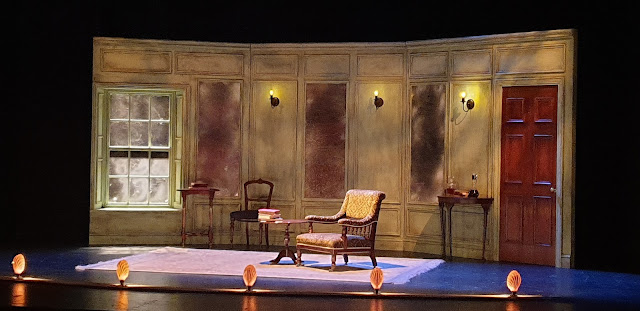
1951, and a chance encounter in a Californian hotel leads to more than just a passionate one-night stand. George and Doris are two happily married people…the problem is, they’re not married to each other. This chance encounter is the start of something, and as the title of the play makes clear, the couple agree to meet up once a year, in the same place, for a no-strings-attached fun and frivolous fling. And so begins a love affair that will continue for 25 years. 

The opening scene perfectly conveys the awkward embarrassment of George, a New Jersey accountant, and Doris, a bored housewife, as they wake up and realisation dawns on them that they have committed adultery three times in one night. George can’t even get Doris’s name right! You can’t help but laugh and squirm in your seat as George and Doris, played by Kieran Buckeridge and Sarah Kempton realise they have thrown their marriage vows into the wind for a night of drunken debauchery. Or have they? They don’t feel guilty, and vow that they will not keep in touch with other, but they will make a pact to meet “Same Time, Next Year.” 

We rejoin this pair of star-crossed lovers five years later in the same guest cottage of the country inn in Northern California where they first met. Both were surprised that the other turned up on the first anniversary, but five years later, the two realise their initial spark can’t be dampened. 

Isla – 18th October 2021 – Theatr Clwyd

I have a love hate relationship with technology. When I was at university in the 90’s, those around me worked on computers whilst I had an electronic typewriter that seemed to have a mind of its own. I think I was nearly 30 before I finally succumbed to enter the modern age and buy myself a laptop.

When I was driving somewhere new, I would study my map book – I would work out which route I was to take and write down the major junctions I needed on post-it notes which I’d stick to my dashboard…discarding each one as I travelled along my hosen route. Now of course it’s much easier, I never bought a Satnav but I have become reliant on Google Maps on my phone…or as I call it Satnav Woman. 

Satnav Woman is brilliant...until she isn’t. She can tell you which route to take and then reroute if there’s an accident or heavy traffic ahead, but she can also be a bit slow telling you where to go, or perhaps a little unclear in her meanings. And then there are the times when she just won’t listen. It’s times like these that Satnav Woman and I will get into a little spat.

SATNAV: “Make a U-turn.”

ME: “I can’t – there are cones down the centre of the road.”

SATNAV: “Make a U-turn.”

Me: “I can’t, it clearly states no U-turn on the signs ahead.”

SATNAV: “Make a U-turn.”

ME: clearly very agitated “Which part of I CAN’T don’t you understand you stupid Bi**h?”

Now I’ve always thought of my interactions with Satnav Woman mildly entertaining. I mean why would you lose your temper with an inanimate object? It makes no sense, and in a rational world you wouldn’t. But perhaps we don’t live in a rational world anymore. Perhaps it’s normal to start shouting “what do you mean” when she’s telling you to “keep left to go right at the fork.” Perhaps I’ve been looking at my interactions with Satnav Woman all wrong.

Isla, a new play by Tim Price, is a co-production between Theatr Clwyd and the Royal Court and directed by Theatr Clwyd’s Tamara Harvey. It explores the relationship between a man and a voice activated digital assistant during the period of lockdown.

Roger’s daughter, Erin, is concerned that her father will be alone during the pandemic and that he’ll forget to take his daily medication. She buys him Isla (think Alexa or Siri) and she will help Roger with his shopping orders, relay telephone calls to him when he has mislaid his ‘phone, remind him to take his tablets each morning – she can even play music when he’s feeling a bit lonesome. Roger is not convinced and explains to Erin (Lisa Zahra) that he takes his statins every morning as soon as the morning newspaper is delivered. He has his own routine; he doesn’t need her interfering in his life.

Erin is clearly worried about her father and concerned that during the pandemic she won’t be able to pop in as freely as she used to. They must keep their distance, so Isla will be a great help. Despite her persuasive attitude, Roger (Mark Lambert) is not convinced, he doesn’t want this technology infiltrating his life, he’s not ready to embrace this new world, and we witness the hilarity and hatred of the digital age as he tries to interact with this machine, literally pulling the plug on it as it continues to frustrate him. But soon stubbornness becomes inquisitiveness and Isla is plugged back in. Roger is in lockdown, he can’t interact with people anymore and as loneliness takes hold, he begins to have conversations with Isla. First of all he asks simple questions and he is taken aback by Isla’s breadth of knowledge, and soon quiz questions turn into shared memories with her, he voices his concerns, his anxieties, his frustrations at not being able to interact with living human souls.

There is a particularly poignant moment when Roger asks Isla to phone his daughter as he desperately wants to talk to her, but he knows she is busy at work, so he tells Isla to stop the call. He then asks her to make the call…then stop the call. This struggle between wanting to speak to his daughter but equally not wanting to be a burden is heart wrenching and shows that technology can never replace the importance of human interaction. We suddenly have such empathy for Roger that we are shocked by what happens next.

Lambert is superb as Roger; we spend each passing day in his company, witnessing the daily monotony of the newspaper delivery, boiling the kettle for a morning cuppa, taking medication; a never-ending cycle of the humdrum of life. A life spent yearning for normality to return…for a father to be able to hug his daughter. We’re called to think about the loneliness of the elderly, how the young are slaves to the workplace if they want to achieve anything, and how today’s modern living can mean relinquishing your privacy.

Kind, sweet, lonely Roger starts to throw a curve ball, he’s become so used to Isla he now throws the same casual abuse at it as I have often done to my Satnav. Casual abuse turns into sexist phrases. But this is a machine, you can’t demean a machine, there’s no harm in a light bit of banter is there? Maybe not for Isla, but Erin used her account to set up the digital assistant for her father – his words become her words, and words have dire consequences. A new layer of complexity is added to the play, a darker more thought-provoking piece of writing. As Catrin Aaron, the voice of Isla, appears on stage in police uniform, you realise that words do have consequences when they are misapplied. Roger is quizzed by PC Jones about the language he has been using, the meaning of the words he has chosen to direct at Isla, the intention that they imply. All too soon we must consider the harsh reality of the links between hate speech and domestic violence. It seems a far reach, but then consider that until very recently, digital assistants have been female. Female names, female voices…servants by any other name and therefore to be treated as dirt.

It's an interesting question why digital assistants have always been female. Some companies have advised it is because the human brain is developed to like female voices; but we know women receive criticism for being “screechy” so this excuse doesn’t really work. Microsoft said it found a female voice to best embody the qualities expected of the digital assistant—helpful, supportive, and trustworthy. Perhaps the real truth of the matter is that companies don’t want to admit to gender bias. A digital assistant is there to be bossed about, Alexa do this, Cortana do that…and up until recently, society expected women to fulfil these roles. And if you lose your temper to a female device, why can’t that spill over into a real domestic setting?

Whilst we don’t see Lambert and Zahra on stage together for much of the play, we still get a sense of their deep connection as father and daughter, and it makes the final scenes even more important, showing that a machine can’t give the love and support that a person needs. Digital assistants...anyone got a hammer?!


Isla by Tim Price https://www.bloomsbury.com/uk/isla-9781350280427/

Theatr Clwyd - Emlyn Williams Theatre until 6th November 2021

Roger: Mark Lambert
Erin: Lisa Zahra
Isla/PC Jones: Catrin Aaron


Isla has come to BBC4. Watch the TV version starring the same cast on the BBC 

Absurd Person Singular by Alan Ayckbourn– 12th October 2021 – Theatr Clwyd

Three married couples. Three kitchens. Three Christmas parties.

Yes, I know it’s October and I’ve mentioned the “C” word, but forgive me, this was another of those long-awaited productions delayed by covid that I’ve been itching to see and believe me it could have been worse; when the tour started in Derby they were having Christmas in June!

Sidney Hopcroft doesn’t have much going for him, he’s uneducated, charmless, a local tradesman, but he has a will and a desire to succeed. His wife Jane is the typical suburban 1970’s housewife, lacking ambition and maintaining a spotless home. And I do mean spotless. The play opens in the Hopcroft’s kitchen and Jane is cleaning. Cleaning, cleaning, cleaning. Everything must be perfect tonight; somehow, Sidney has persuaded her to throw a Christmas Eve party to impress his bank manager and a local architect.

As the celebrations begin, unsurprisingly, these three odd couples all end up in the kitchen – I mean this is a party and all the best parties I’ve ever frequented have ended up in the kitchen. You can tell a lot about someone from their kitchen or at least that’s what banker Ronald and his wife Marion think. This tiny, bright orange Formica kitchen might not be to everyone’s taste, certainly not Marion’s, but it is spotlessly clean, and it has simple mod cons like an automatic washing machine which Jane is so excited to tell her guests about. Chaos reigns supreme and the atmosphere changes from quiet anticipation to hilarity as the audience witness the comic capers of the Hopcroft’s as they desperately try to win over the Jacksons and Brewster-Wrights.

How many people does it take to change a lightbulb? Six according to Alan Ayckbourn - one to try committing an act of suicide and five to be so self-absorbed that they don’t notice. It’s a year later, and it’s the turn of architect Geoffrey Jackson and his wife Eva to host the Christmas festivities. Eva is sat in a more upmarket traditional pine kitchen, it feels more spacious than the Hopcroft’s kitchen, but void of any personality. There’s no automatic washing machine here, instead laundry is dumped in a basket in the corner; the oven is filthy and crumpled bits of paper adorn the floor. Sat at a cluttered kitchen table, Eva is penning a suicide note, but her husband is too wrapped up rummaging through the cupboards trying to find some drinks for the evening’s party which he’d forgotten about. Enter Jane, wearing slightly better clothes than last year, but still obsessively cleaning. As Geoffrey and Eva’s world is falling apart, she fills a bowl with water and merrily chats and sings to herself as she scrubs their oven clean, blissfully unaware of the dark torment raging in Eva’s head. Helen Keeley deserves a special mention for the way she managed to convey so much emotion as the catatonically depressed Eva, despite remaining mute for most of Act Two.

The third and final Christmas and more cracks are beginning to show as the tables have turned on the fortunes of our three couples. A quick transformation of the stage and we’re sitting in the freezing dining room, just off the kitchen, of the Brewster-Wrights. Eva has transformed from the suicidal blond to the supportive friend to the alcoholic Marion who no longer cares about her appearance and is oblivious to the cold as she flounces around in her nightdress.

Ronald’s bank now depends on the deposits from Sidney whose business has slowly and steadily grown. After the literal collapse of one of Geoffrey’s architectural designs, he is now dependent on working on Sidney’s housing projects – something that he poured scorn on only a few years earlier. But needs must if you want to keep the roof over your head. The comic twists and poignant moments take another turn as the Jacksons and Brewster-Wrights pretend to not be at home when the Hopcroft’s arrive.

There’s an element of Chekhov despair drifting throughout the play; Sidney and his little wife were a joke, their role was to flatter the egos of their betters; but now, they are the ones calling the shots. During the last act Sidney, once nervous and desperate to find favour, has a newfound confidence and has everyone dancing to his own tune as he demands that everyone plays his party games. He has brought gifts, knowing full well the compliment can no longer be reciprocated. He did what he had to do in the 1970’s get rich culture to make something of himself, whilst the lazy banker and architect let the grass grow under their feet and their wives found solace at the bottom of a bottle of gin or a packet of anti-depressants. Let’s hope Sidney remembers what rises to the top can quickly sink to the bottom if he’s not careful.

Just like Dickens’ ghosts of Christmas Past, Present and Future, Absurd Person Singular takes you on a journey of self-awareness; but rather than a selfish man trying to redeem himself, this play takes you on an emotional roller coaster through the nuances of the different classes, how they look at themselves and each other, and it gives a comic nod to the dangers of holding social gatherings. This is not a play stuck in the 1970’s, sadly it remains prescient today. We don’t need to throw parties anymore to try to impress, we’re now a society obsessed with social media, wanting to achieve the unattainable…whatever the cost.


Cast


Sidney Hopcroft: Paul Sandys
Jane Hopcroft: Felicity Houlbrooke
Geoffrey Jackson: John Dorney
Eva Jackson: Helen Keeley
Ronald Brewster-Wright: Graham O’Mara
Marion Brewster-Wright: Rosanna Miles

The 2021 tour concluded at Theatr Clwyd.


Being Mr Wickham – 8th October 2021 – Theatr Clwyd

Back in 1995, the BBC made what I would consider the quintessential adaptation of Jane Austin’s 1813 novel Pride and Prejudice. The six-part series elevated actor Colin Firth to fame when he set hearts a flutter whilst striding out of the lake at Pemberley as the dashing Mr Darcy, wet white shirt dripping and clinging to his torso. The foil to Mr Darcy was George Wickham, played by Adrian Lukis, a man who shared his history with Darcy.

Wickham was a charming militia officer who manged to attract the sympathy of the heroine Elizabeth Bennett. She believed Darcy to have mistreated Wickham in the past and it took the interaction of her aunt to forewarn her that the path to happiness was most certainly not to be found in George Wickham. As the story continues, the aunt’s warning plays out and it is revealed that Wickham is a manipulative cad. He is a wastrel, a compulsive liar, a seducer and live the life of a rake…in fact Jane Austin doesn’t really have anything nice to say about the man.

Now whilst I could never envisage dear Lizzie Bennet ending up with the dastardly Mr Wickham, I must confess to having a bit of a soft spot for him; I mean think of Dolokhov in Tolstoy’s War and Peace, you’re not really supposed to like him, but there’s just something utterly compelling about these characters. I think Dolokhov was rather misunderstood, the question is, was George Wickham?

‘Am I to be the villain of my own story?’

You may recall that our last image of Wickham is when Darcy forces him to make an honest woman of Lydia Bennett after he has eloped with her. So, what happens to Wickham after Pride and Prejudice has ended? Adrian Lukis is back as Mr Wickham and this play he has written and stars in attempts to provide an answer. It’s time to push Mr Darcy to one-side and give George Wickham a chance to put the story straight, after all, he isn’t going to tell the same tale that Jane Austin would.

It is Wickham’s 60th birthday, following a flirtation at his party, his wife Lydia has stormed off to bed leaving him all alone with a bottle of claret and a whole host of memories for company. Just as we can’t forget Mr Darcy, neither can he, his takes us back to his earliest encounter with Darcy when they were children, through the period we bore witness to in Pride and Prejudice, to what happened after they were both married. There are often two sides to a story, and the storyteller will always tell you the rose-tinted spectacle version.


Adrian Lukis is a charismatic actor, making you hang onto his every word as he draws you back into being complicit with Wickham’s bad boy behaviour of the past. Wickham’s currently worried by his diminishing looks and his aging knees, "I'm told I'd pass for 40" … "on a good day." That pause, that sigh, the raised eyebrow…how can you not be transfixed by this scoundrel?

Being Mr Wickham is a fervent defence of a man the audience knows cheated and lied to gain every advantage he could. He was willing to accept his life as a vicar. He genuinely loved Georgiana. He had a perfectly acceptable defence of his elopement with Lydia. He has told these stories to himself so many times that he now truly believes in them. His trip down memory line is so far apart from Jane Austin’s you’d be forgiven for thinking that two different people were being explored. But this is what makes the play so engaging – to hear a different perspective. Austin would be horrified that Wickham could potentially have a softer, kinder side, but we know from his past he manipulated those around him…and a leopard doesn’t change his spots. Just as Elizabeth Bennett fell for his charms, he now has a whole audience eating out of his hand, hanging onto his every word as he charms his way through this hour-long production making the audience laugh along the way.

‘When Lydia is happy, I am happy; When Lydia is asleep, I am delighted.’

It’s a well-balanced play; whilst there’s a melancholy to some of his reminiscences, there are elements of light to the shade, although often these lighter moments point to a life that’s not as happy as it may seem, ‘When Lydia is happy, I am happy; When Lydia is asleep, I am delighted.’ As he wanders over to the window to watch the comings and goings of his neighbours, his excitement is palpable about the possibility of his next-door neighbour’s daughter eloping.

The writing is particularly vivid as Wickham recalls the Battle of Waterloo; the walls of the set turn dark, and a military uniform appears from what were frosted windows, and he recalls the demise of his dear friend Denny, shot next to him on the battlefield. He Byronesque persona shone through as he recalled the losses of various courtesans he knew and loved, and other people who had passed through his life who were no longer there to share in his current trials and tribulations.

We journeyed through all his life…his childhood and his mother abandoning him and how young Darcy took the wrap for young Wickham stealing a bottle of Brandy. We learnt how unhappy he was at school, how Darcy paid him off instead of him having a career within the church and how he spent that money chasing wine, women and song. How he remained with Lydia because they made each other laugh, but despite everything this was not a man to feel sorry for. He has had his ups and downs like anyone else.

Just as Colin Firth is Mr Darcy, Adrian Lukis is Mr Wickham and it was a delight to see the character brought back to life as the layers of his life were peeled away like an onion. There was a reason he could charm the Bennett sisters, and throughout the evening he charmed the audience just as easily. It was a joy to watch this thoughtful “sequel” to Pride and Prejudice which fans of the novel could delight in and an even bigger joy and surprise when Adrian returned to the stage as himself to take part in a short Q&A session which was just as entertaining as the play.

If you ever get the chance to see this delightful one-man show – take the opportunity as it’s worth it.

2021 Tour dates:

Theatr Clwyd (8-9 October)
Darlington Hippodrome (11-12 October)
York Theatre Royal (14-16 October)
The New Wolsey Theatre, Ipswich (19-20 October)
Connaught Theatre, Worthing (21-22 October)
Yvonne Arnaud Theatre, Guildford (28-30 October)
The Haymarket, Basingstoke (1-2 November)
Devonshire Park Theatre, Eastbourne (4-6 November)


UPDATE!  The tour might be over but you can watch online until 30/04/2022 - https://originaltheatreonline.com/productions/28/being-mr-wickham


The Hound of the Baskervilles – 21st September 2021 – Theatr Clwyd

After the last 18 months, we all could all do with exercising those chuckle muscles a bit and where better to do it than by watching live theatre? Sir Arthur Conan Doyle’s most celebrated adventure has been given the most glorious comic transformation by the Original Theatre Company.

The world-renowned detective Sherlock Holmes and his ever-faithful sidekick Dr Watson are tasked with unravelling a mystery regarding the untimely death of Sir Charles Baskerville. Rumours abound that there is a cursed giant hound roaming the moors which surround the Baskerville home, so it is up to Holmes and Watson…or should that be Watson and Holmes, to use their wit and guile to save the remaining Baskerville heir from succumbing to the same fate that has befallen Sir Charles.

This ingenious adaptation combines wonderful comic performances by all three cast members who take on a variety of roles throughout the evening. Serena Manteghi plays a whole host of colourful characters, she is a delight as both Sir Charles Baskerville and Sir Henry Baskerville, and she swiftly morphs into a London cabbie and three yokels of varying degrees of intelligence. Dr Watson, played by Niall Ransome, is the competent, incompetent, faithful sidekick played with puppy like charm, whilst Holmes played by Jake Ferretti retains an element of that emotional distance that Holmes is renowned for.


The show is a parody of many theatrical styles, there are moments of melodrama intertwined with the farcical and bordering on a night at the panto. Whilst the show starts rather gently, the momentum continues to build; the actors change characters, gender, accents, and costumes at lightning speed; or at least that’s what I thought. After the interval, Jack Ferretti came back on stage rather ruffled by a Twitter notification during the break, so we were treated to a resume of the play at warp factor! My sides were aching at the sheer ludicrousness of it all…and that’s before we were treated to a Tango worthy of Strictly!

More camped up spooky Scooby Doo whodunnit than scary crime drama, it’s a great excuse to treat the family to a fun filled night out, and after the last couple of years, who wouldn’t want that?!

The Hound of the Baskervilles - produced by The Original Theatre Company & Octagon Theatre Bolton


Jake Ferretti: Sherlock Holmes
Serena Manteghi: Sir Henry
Niall Ransome: Dr. Watson

 2021/2022 Tour dates:

Cambridge Arts Theatre (16-18 Sept)
Theatr Clwyd (21-25 Sept)
Exeter Northcott Theatre (28 Sept-2 Oct)
Malvern Theatres (5-9 Oct)
York Theatre Royal (19-23 Oct)
Devonshire Park Theatre, Eastbourne (26-30 Oct)
Richmond Theatre (2-6 November)
The New Wolsey Theatre, Ipswich (9-13 Nov)
Salisbury Playhouse (15-20 Nov)
Theatre Royal Bath (24-28 Jan)
The Lowry (31 Jan – 5 Feb)
Belgrade Theatre, Coventry (8-12 February).

 Further 2022 tour venues are to be announced.


Dial M for Murder - – 27th September 2021 – Theatr Clwyd

Retired champion tennis player Tony Wendice (played by Strictly Come Dancing winner Tom Chambers) wants to murder his socialite wife Margot (X-factor finalist Diana Vickers.) Not only has Margot been unfaithful to her husband by having an affair with crime writer Max Halliday, but she’s also sitting on a small fortune which her husband needs to get his hands on the because he’s broke. Whilst he may have several trophy’s lining his front room shelves, he was playing tennis in an era where tennis players weren’t paid.


Many people will be aware of Alfred Hitchcock’s 1954 film version of Dial M for Murder starring Ray Milland and Grace Kelly, however, it was BBC television that first aired a production in 1952; the same year that a theatrical version was also performed.

As I loved Hitchcock’s version, I was rather excited to finally watch this play; I’d bought tickets pre-covid when the tour was first announced, but unfortunately the production had to be postponed several times until it was deemed safe to reopen our theatres and touring could commence.

Is there such a thing as the perfect crime?

Tony has spent months perfecting the perfect murder, however, he’s a coward who won’t get his hands too dirty, so he enlists the help of an old acquaintance from his Cambridge University days, Charles Swann. Tony is aware that Charles became a small-time criminal and because this is the perfect crime, he can use his knowledge of Charles’ history to his advantage. He arranges a meeting with Swann, claiming he wishes to purchase the car Swann is selling, but over a few drinks, he confides in Swann about Margot’s infidelity. Six months earlier, Tony had stolen Margot’s handbag which contained a love letter from Mark, and he sent her an anonymous blackmail letter about it. Whilst confiding in Swann, Tony hands him the love letter to read, now that the letter has Swann’s fingerprints all over it, Tony tells Swann he can either accept £1000.00 to murder Margot, or he can be unveiled as the mystery man who blackmailed her. Swann grudgingly agrees to become Tony’s accomplice, and Tony explains his perfect plan for murder…

Oh what a tangled web we weave, 
When first we practice to deceive'…

 Mark Halliday is back on UK soil and visiting Margot. Tony tells Mark he should accompany him to a stag party the following evening thus leaving Margot home alone. Tony will hide Margot’s door key under the mat so that Charles can let himself into the property and hide. Tony would then telephone Margot from the party and whilst answering the phone, Charles would strangle her and then leave signs of a burglary before leaving the flat and replacing the door key back where he’d found it. Now the only problem with Tony’s plan is that it is reliant on everyone playing their part perfectly, and the only fly in the ointment is that Margot doesn’t know what her role in his devious scheme entails. So, just like Marmion, we’re about to witness a domino effect of complications which begin to spiral out of control.

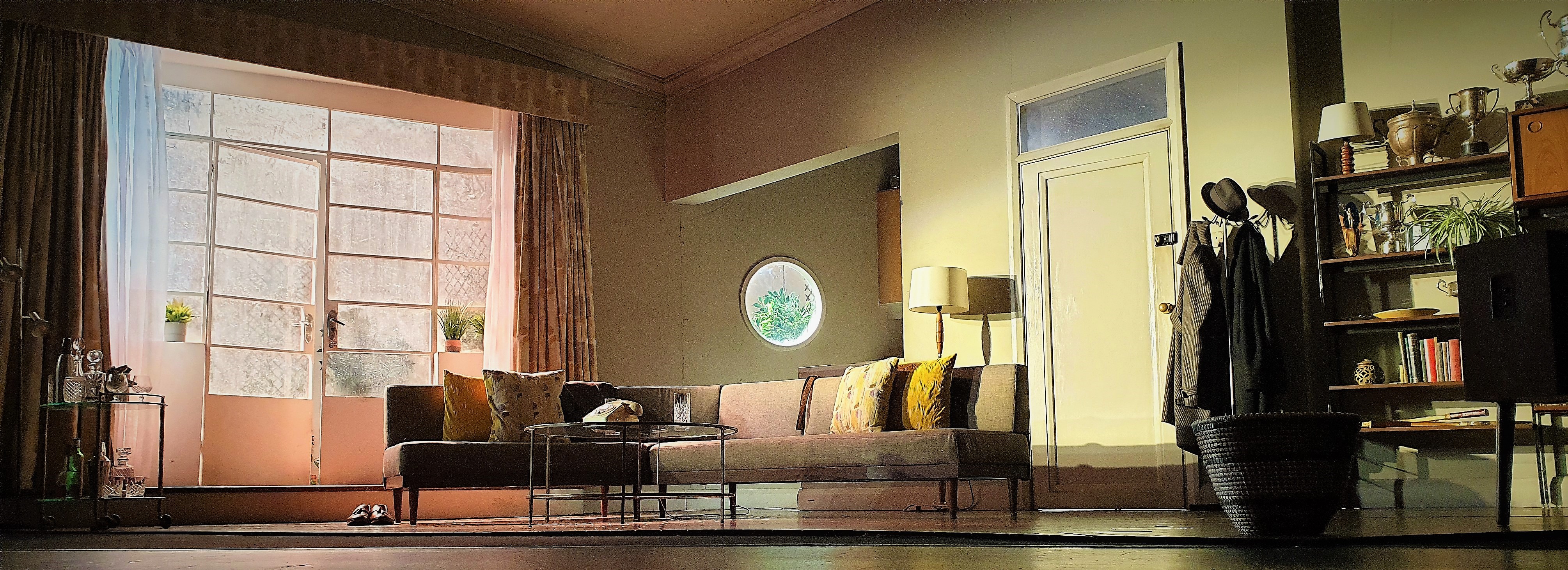
Set in the front room of a ground floor flat in Maida Vale, this production is set a decade later than the original, a transformation that doesn’t add anything to this clunky new production of the classic thriller. The soundtrack opening the show is the 1959 classic The Flamingos - I Only Have Eyes For You, which immediately transported me back to The Deep Blue Sea at The National with Tom Burke and Helen McCrory. I say the production was clunky, because whilst I enjoyed the play, it wasn’t the edge of the seat spine-chilling thriller I was expecting. Instead, director Anthony Banks has injected a light-heartedness into the staging, which suits Tom Chambers’ acting style, but means that parts of the play which should be extremely dramatic, elicit raucous laughter from audience.

Tom Chambers appears to be having great fun playing the role of psychopath Tony Wendice, but he is too maniacal, and it undermines the cold calculated mind of a wife killer; I also found the smug self-esteem overbearing and the references to his past tennis career in his dancelike movements across the stage unnecessary.

Whilst all the actors were good, I felt there was a distinct lack of chemistry between the central trio, which made the whole plot unbelievable, and I didn’t really care who was sent to the gallows in the end.  And then there was the murder itself.

The joy of this storyline is that the audience has had it spelt out to them from the start what is supposed to happen. The tension in the air should become palpable as we move through Tony’s plan and see it start to fracture, but the comedic edge dilutes the tension. There isn’t that sense of shock from Margot, surprise yes, but not a deep dark horror that someone has just tried to kill her. The murder scene needed more conviction to keep me on the edge of my seat.

It was an enjoyable evening out, but it was less thriller and more comedic caper for my liking; but maybe a bit of tactical light relief is what people need in the current climate, and if that’s what the audience want – this production delivers on that front.


Dial M for Murder

Theatr Clwyd – Anthony Hopkins Theatr from

Running time 2 hours 20 mins

Tony Wendice: Tom Chambers

Margot Wendice: Diana Vickers


27 September – 2 October 2021 Theatr Clwyd, Mold
5 – 9 October 2021 Cambridge Arts Theatre
11 – 16 October 2021 Everyman Theatre, Cheltenham
18 – 23 October 2021 Lyceum Theatre, Sheffield
26 – 30 October 2021 Milton Keynes Theatre
2 – 6 November 2021 New Theatre Cardiff
9 – 13 November 2021 Palace Theatre, Southend On Sea
15 – 20 November 2021 The Lowry, Salford
29 November – 4 December 2021 Festival Theatre Malvern


Missing Julie - by Kaite O'Reilly - Theatr Clwyd 17th Sep 2021 (Preview)

Theatr Clwyd - 2020 Regional Theatre of the Year. It’s easy to see why. During the darkest days of the pandemic, the theatre not only got involved with the local community, but it continued to strive to help creatives in the industry. An opportunity to stream several free online readings whilst the theatre curtain remained drawn was also grabbed.

On 5/11/2020, a reading of Kate O’Reilly’s brand-new play Missing Julie was aired. Over a coffee in the theatre, the foundations of relocating Strindberg’s classic Miss Julie to post-war Wales had begun to take shape. Performed by Sophie Melville (The Missing, The Pact); Tim Pritchett (Casualty, Black Mirror); and Victoria John (Miranda, Little Britain) I enjoyed the reading and looked forward to a time when the play would grace the stage of Theatr Clwyd.

Set in a Welsh stately home in 1921, just after the First World War, Missing Julie is described as a modern adaptation of Strindberg’s Miss Julie. Whilst the story has moved to a century ago, it still feels like a contemporary piece, but it allows the dynamic between the characters to be strengthened and throughout it still remains faithful to the original storyline. After the war was a period of grief and mourning, but for some it was also a period of change, of hope, of possibilities. Many men returned home with missing limbs and this play explores their lives and the interactions they had after returning home.

The play is performed in Theatr Clwyd’s “Emlyn Williams Theatr” an intimate space which allowed Georgia Lowe’s simplistic but effective traverse staged set design. Just like when I watched Miss Julie in Keswick a few years ago, https://www.imblatheringnow.com/2017/09/miss-julie-theatre-by-lake-keswick.html the audience watches the action from either side of a long kitchen table. Whilst Keswick’s set was a homely kitchen, this set is spartan matt black, with Perspex walls housing flood lights at either end. Large bells hang ominously from each corner of the set, and a large pan is set at the end of the table, bubbling above a burning flame.

Out of the cast who did the online reading, only Tim Pritchett as John remains. Heledd Gwynn takes on the titular role and her performance is mesmerising from the moment the lights go up on stage. Athletic and balletic, she contorts her body in all manner of shapes as John watches on, stating to Christine that the lady of the house has obviously lost her mind. Julie however is not a madwoman, but a heady mixture of contradictions. It is unsettling watching her as she sways from her desperate yearning to be with John, a man deemed to be beneath her, and her reliance on the shackles that bind her to her current lifestyle of the wealthy classes.

Rather than being abandoned by her fiancé, this Miss Julie’s world has been turned upside down as she has lost her man in the carnage of the trenches. She is one of the surplus women, destined to become a spinster. Her father’s servant John has lost a leg, we assume in the war, but it transpires that it was caused by a shooting accident in his youth. It’s not just John who is bearing scars of the past, Christine the cook is also dealing with her own loss; the grief she feels for her dead husband is palpable.

‘What do you know about magnificence?’

John is tired of being working-class, taking his orders from people who are no better than him. He aspires to better things, but this is a simple world of going to chapel, knowing your place and where having aspirations should be met with caution. John may appear to have certain limitations, but he will not let the loss of a limb stop him from pursuing a life away from servitude. He is Julie’s opposite in several ways. John and Julie continually bait and stalk each other throughout the play, but both give focused and assured performances maintaining a sizzling level of tension throughout. We know how the original story pans out, but maybe this time Julie will fathom out what she really wants.

Images as per Twitter Stream

Overseeing all the action is Christine, played by Catrin Aaron. All three actors remain on the stage throughout the play, and as she sleepwalks around the perimeter of the stage, the atmosphere becomes more claustrophobic. The old ways are being swept away and for her this is a heavy burden to bear. Her sudden outburst is heartfelt, and suddenly you realise that from the moment the play begins, to when she says to John “what do you know about magnificence?” she is the one who has the most tragic life of them all.

Whilst this isn’t radically different to the original play, it was thoroughly enjoyable to watch and to look through the eyes of a world that was on the cusp of change. Often disabled characters in classic plays are to be pitied or ridiculed, but Kaite O’Reilly has created an opportunity to give a voice to those who are overlooked or treated with contempt, and she has given them an inner strength. Setting it in a period where many men came back from the war supporting life changing injuries opened a conversation about how people with disabilities are treated, both then and now.

Missing Julie by Kaite O'Reilly

Theatr Clwyd - Emlyn Williams Theatre from 21 September until 9 October.

Running time 75 mins

Julie: Heledd Gwynn

Christine: Catrin Aaron

John: Tim Pritchett

A Splinter of Ice – Theatr Clwyd

📅 Sat 12th June – Fri 25th June

Running time 2hrs 10 mins (inc interval) 

Betrayal. “I hate the idea of causes, and if I had to choose between betraying my country and betraying my friend, I hope I should have the guts to betray my country.” – E.M.Forster

Moscow, February 1987, two of the greatest 20th Century novelists Graham Greene and the Soviet spy Kim Philby are reunited. Philby had been Greene’s supervisor and friend at MI6 30 years earlier, but at the time of the meeting Philby had long been exposed as a communist double agent and was living in Moscow with his final wife, Rufa – a Russian memoirist.

I had seen several advertisements on social media for The Original Theatre Company’s online recording of the production, and I was on the verge of buying a ticket when I spotted that the play was touring and coming to Theatr Clwyd. Whilst online plays have been a salvation throughout the pandemic, there is nothing to beat the feeling of sitting in a theatre watching a live production.

Graham Greene served in MI6 in the 1940s, which is where he met and became friends with Kim Philby, a double agent, who in 1963 was revealed as the “third man” in the Cambridge Spy Ring.  Ben Brown’s play imagines how the reunion between Greene and Philby would have played out and whether Philby not only betrayed his country, but whether he betrayed his friend as well. It also scratches under the surface of one of Greene’s most famous stories, The Third Man, which was released as both a film starring Orson Welles and a novella with which Greene could use as the basis for his film script. Questions arise during the evening as to how much of Philby’s secret life Greene was aware of, and whether he was the basis of the character Harry Lime.

The set is a simple affair, a Soviet-era drawing room in retro shades of yellow and brown, so the play relies on the strength and vigour of the conversations between the two men played by Olivier Award-winning Oliver Ford Davies (Game of Thrones, Star Wars) and Stephen Boxer (The Crown).

This is an extraordinary political drama exploring a long and unlikely friendship, woven of both loyalty and deceit; but throughout the play, we never really get to know either man well enough to condemn or acquit them for their actions. Brown’s dialogue is intelligent and often humorous, and both parts are played well enough, but there is a lack of depth and intensity between the two protagonists. It was hard to imagine either party had anything left in common with the other to want to “catch up on old times.” Greene made his name trivialising spying with his novels, Philby spent most of his life living in Russia feeling the aftereffects of his espionage after he was exposed.

The play commences with a lot of small talk over glasses of vodka, and we learn a lot about Philby’s life in Russia. He still enjoys reading The Times, his family ensures he has Scotch sent over, and there is the sense that whilst he has kissed Britain goodbye, there is still a thread tugging at him that he cannot let go of. We learn about Philby’s actions working at MI6 and the human cost his work as a spy took, but we never really get past the surface as to why he betrayed his country. Greene tries to subtly extract information from Philby but never really shows any intent, instead, Philby moves the focus onto whether he was the inspiration for Harry Lime in The Third Man, a belief that Greene is quick to quash.

There is a lot of background information supplied in the process of conversation about the events that happened in the 30 years before this meeting, but there is nothing substantial for the audience to be shocked or surprised at. “My book was published and you kindly wrote the foreword,” says Philby to Greene.

Why? Why did Philby write a book? What explosive content did it contain? Why was Greene asked to write the forward, and why did he agree? I suppose I’d better pick up a copy of “My Silent War” to find out! I presume there had to be something more substantial than just because they were friends and once worked together. And what was the real reason for Greene suddenly turning up? It was too convenient that he was in town for a star-studded peace conference and thought he would just drop by. Throughout the play, Philby seems on edge as he is questioned by his old friend; is this because the friend cannot be trusted and is still the enemy?

The most enthralling part of the play is when Greene challenges Philby about agents sent behind enemy lines to what would be certain death; and how being a spy questions a person’s loyalty to their friends and family, and with that, their morality. Philby confesses to betraying his own father and about the innocent lives which were lost because of his espionage (although he claimed many were ex-Nazi anyway and somehow deserved their fate), but he also claimed he was never a double agent. He seemed at peace with his decisions, but as the play drew to a close, Philby’s wife, who for most of the first act is just seen taking Greene’s coat before ushering him to the drawing room and then scurrying off to the kitchen, fills in yet more of Philby’s backstory. It seems that Philby lives a solitary life in Moscow, his inability to speak Russian means he cannot partake in a full social life, and his former career as a spy means that people don’t wish to know him. He is reliant on Rufa for everything. Philby states he has no regrets about his past, but as the final sombre scenes play out, he cuts a dejected and lonely figure on the stage.

The premise of the play is an exciting one, the audience has been invited to watch a fascinating moment in history when two great men meet, but they are let down by a script that neither takes us deep to the heart of either man or one that attempts to understand their motivations; especially the motivations of Philby who moved from a communist allegiance as a student and moved onto passing secrets to the Soviets, culminating in the certain deaths of many agents. Graham Greene famously stated that there was a “splinter of ice in the heart of a writer” – meaning that whilst the writer can empathise with a person’s suffering, there is observation and notetaking being done in the background ready to be shared in a later book. Maybe that is why this play doesn’t have the answers we crave, or perhaps it’s just that both individuals took their secrets to the grave.

(Viewed Thursday 24th June)


A Splinter of Ice UK Tour 2021

Starring Oliver Ford Davies (Game of Thrones, Star Wars) as Graham Greene, Stephen Boxer (The Crown) as Kim Philby and Karen Ascoe as Rufa Philby.

8 - 12 June - MALVERN Festival Theatre - www.malvern-theatres.co.uk 

15 - 19 June - GUILDFORD Yvonne Arnaud Theatre - www.yvonne-arnaud.co.uk 

21 - 26 June - MOLD Theatr Clwyd - www.theatrclwyd.com 

28 June - 3 July - BATH Theatre Royal - www.theatreroyal.org.uk 

6 - 10 July - YORK, Theatre Royal York - www.yorktheatreroyal.co.uk 

13 - 17 July - EDINBURGH King’s Theatre - www.capitaltheatres.com 

19 - 24 July - CAMBRIDGE, Cambridge Arts - www.cambridgeartstheatre.com 


ONLINE

Starring Oliver Ford Davies (Game of Thrones, Star Wars) as Graham Greene, Stephen Boxer (The Crown) as Kim Philby and Sara Crowe (Four Weddings and a Funeral) as Rufa Philby.

Tickets:

Standard - £20

Supporter Package - £22.50 - Includes digital programme 

Premium Package - £100 - Includes signed script by a creative team member of your choice, digital programme and supporter credit on the final films.

Watch anytime, as many times as you like until 31 July 2021. Available worldwide.

For The Grace Of You Go I by Alan Harris – Theatr Clwyd

📅 Sat 12th June – Fri 25th June

Running time 1hr 15 mins 

Jim’s life is going nowhere. He spends his days topping pizzas with pepperoni. He thinks he has found the answer to his problems whilst watching the film “I Hired a Contract Killer.”All he has to do is get someone to kill him. What on earth could go wrong with that?

This is my second post-Covid show at Theatr Clwyd and on first sight the stage is an assault on the eyeballs, all acid green, bubble gum pink and sunshine yellow. But don’t let the Crayola crayon set fool you, Welsh writer Alan Harris has delivered a darkly comic play with a poignant message running through it.

The tale is a three-hander, focusing on Jim, excellently played by the haunting Rhodri Meilir (Hidden/My family) who, following the death of his mother, has been suffering from the mental health condition, depersonalisation disorder. 

As part of a Department for Work and Pensions (DWP) pilot scheme, Jim has been selected to work on the production line of an artisan pizza company. His job is to ensure that he puts the requisite pieces of pepperoni on a pizza, in the manner of a handcrafted pizza, not as though a robot had done it. Despite his best efforts, Jim never quite manages to hit his productivity quota, causing his manager Irina (Remy Beasley – Stella/The Salisbury Poisonings) to intervene which gives the audience an insight into the pressures she is being put under by her boss. Rather than Irina’s pep-talk buoying Jim on, he instead arranges the meat on his pizzas into messages, desperate cries for help in meat form. 

Jim meets Mark (Darren Jeffries – Hollyoaks) at a film club for people suffering with their mental health. Unbeknown to Jim, Mark is married to his boss Irina. Following a viewing of Aki Kaurismäki’s film “I Hired a Contract Killer” Jim asks Mark to kill him – it’s the only way he believes he can find peace from the banality of everyday life. 


The narrative of the film begins to weave into their lives, and this is echoed by partly staging the show via video. As the film is shown on several screens peppered across the stage, Jim mirrors the words and movement of the film. There’s an almost balletic quality in his movements which are mesmerising. Here is a man completely on the edge of society, failed by the state which should be there to protect him and provide him with some dignity, but instead is exploiting him in a work scheme which he is set to fail at from the very beginning.

The play was originally due to premiere at Theatr Clwyd in 2020, and it was great to finally be able to sit inside a theatre and watch real people on a real stage. During lockdown, Theatr Clwyd staged an online reading of another play by Alan Harris – Love, Lies and Taxidermy; an offbeat tale of the son of a Polish taxidermist going on a first date with the daughter of a failing ice-cream salesman in a Tesco in Merthyr Tydfil. Both plays showed Harris’s compassion for his characters, and whilst I was in awe of the staging, the acting and the sensitivity in the writing, I couldn’t help but find myself thinking it was lacking in something I couldn’t put my finger on.

It was an ambitious production taking on the subject of mental health in a dark but comedic way, showing how society thinks that with a catchy self-care slogan people’s conditions will miraculously fade away. However, as a piece of metatheatre, where the audience is both laughing and feeling empathy to a character, I think the farcical or more ludicrous elements of the show were lost because they faded into the characters’ normal lives and so elements of the play became a little confused.

All in all, I thought it was an enjoyable drama and I hope that when theatres get back on their feet, that this play is given the opportunity to tour as it’s well worth watching. For those who have been unable to watch, the script is available from Nick Hern Books and other good retailers.


(Viewed Saturday 19th June 2021)


UPDATE

If you missed watching this fabulous production, you can watch online until Wednesday 14th July. If you're a Theatr Clwyd member you can watch for free. Head to the website for full details.

https://www.theatrclwyd.com/event/for-the-grace-of-you-go-i-online?utm_campaign=12496371_For%20The%20Grace%20Of%20You%20Go%20I%20-%20ONLINE%20%28general%29&utm_medium=E-mail&utm_source=Theatr%20Clwyd%20E-mail&dm_i=1FDJ,7FU9F,807YTR,U8AO6,1

Currently Trending