Catch Me If You Can by Jack Weinstock & Willie Gilbert – 28th March 2022 – Theatr Clwyd


As a kid growing up in the 70’s and 80’s, I can’t say I watched that much TV. In fact, I don’t think we got a colour TV until the end of the 80’s. I think I was the only child in school not to know what colour Posh Paws was on The Multi-coloured Swap Shop, and who understood what Ted Lowe meant when he uttered his immortal phrase about “the pink is next to the green” on a live snooker commentary.  

Whilst I’d hear all the hoo ha about Dallas and Dynasty in the school playground (and of course that major news story, who shot JR Ewing) I never watched either show; as a family we didn’t watch soap operas, but that didn’t mean I wasn’t intrigued to watch TV legends Patrick Duffy, Bobby Ewing in Dallas, and Linda Purl, Homeland, if they were appearing on a stage near me!

Now, before we start with the review, let’s make something clear, this Catch Me If You Can is NOT a stage production of the 2002 Leonardo DiCaprio film, this is a very different beast of a story! The play is based on a French play, Trap for a Lonely Man, by Robert Thomas, however, this adaptation written by Jack Weinstock & Willie Gilbert is a thriller which made its debut on Broadway in 1965.

Newly married Daniel Corban (Patrick Duffy) is at a remote lodge in the Catskill mountains; his wife has been missing for a few days, and the local police believe it is nothing more than a lover’s tiff. The cleric, Father Kelleher, visits Corban with the welcome news that Elizabeth has been found and reunites the couple. The only fly in the ointment is that Daniel is insistent that this woman is not his wife Elizabeth, whilst she is equally insistent that she is…and so opens this intriguing thriller in which a baffling train of events in which no-one is who they appear to be and nothing is what it seems to be.

Washington Irving’s - The Legend of Sleepy Hollow by Phillip Meeks – 8th March 2022 – name of theatre

I love, love, love the comic book effect programme for The Legend of Sleepy Hollow, but that’s pretty much where my love for this production began to run out.

“Don’t pass by. Stay forever.” Beseeches the sign outside of Sleepy Hollow, but this is not a place you are likely to linger. The show is loosely adapted from Washington Irving’s short story, and unlike Tim Burton’s film starring Johnny Depp, it remains true to the original in that it follows the arrival of schoolmaster Ichabod Crane (Sam Jackson) to the superstitious hamlet of Sleepy Hollow.


The Headless Horseman represents a past that never dies, but always haunts the living.


Journalist and biographer Washington Irving, born in 1783, created arguably the earliest of the American-made horror creatures…The Headless Horseman. Ichabod Crane, a young man from the city of Boston, arrives in the backwater of Sleepy Hollow to open a school, but in reality he has a darker motive for coming to this small hamlet. Irving was obsessed with early American history, the folklore surrounding the Headless Horseman maintained that the Horseman was a Hessian trooper during the American Revoltunary War and killed during the battle of White Plains in 1776. The legend stated that he lost his head by an American cannonball, and whilst his body was collected, his shattered head remained on the battlefield. He was buried in the cemetery at Sleepy Hollow from where he was said to rise as a malevolent ghost, seeking his head, or a replacement from someone else.

The Da Vinci Code, from the novel by Dan Brown – 15th February 2022 – Theatr Clwyd

I’ve read Dan Brown’s thriller regarding Catholic conspiracy and murderous Opus Dei monks, I’ve watched Ron Howard’s film adaptation, and now here I am watching Luke Sheppard’s theatre adaptation. You would be forgiven for thinking I am a mega-fan of Dan Brown, but you’d be wrong – much like the Harry Potter books, I only read the Dan Brown novels because I didn’t want to miss out on what everyone else was raving about. I was intrigued to see how all the complex plot twists and turns would be negotiated on the stage, (plus Danny John-Jules, best known for Red Dwarf, was due to tread the Theatr Clwyd boards!)

The curator of the Louvre Museum in Paris, Jacques Sauniere, has been brutally murdered. At the side of his body are a series of baffling codes, and more importantly, a message to the police to find the symbologist Prof. Robert Langdon. Nigel Harmon (Eastenders) played the role of Robert Langdon, the professor and symbolist, and Hannah Rose Caton played his fellow fugitive and police cryptologist Sophie Neveu who join forces to solve the complex puzzles. Their quest leads them to the works of Leonardo da Vinci and into the depths of history to solve both the murder and break a labyrinthine code so that a historical secret is not lost forever.

Same Time Next Year by Bernard Slade – 8th February 2022 – Theatr Clwyd (Anthony Hopkins Theatre)

1951, and a chance encounter in a Californian hotel leads to more than just a passionate one-night stand. George and Doris are two happily married people…the problem is, they’re not married to each other. This chance encounter is the start of something, and as the title of the play makes clear, the couple agree to meet up once a year, in the same place, for a no-strings-attached fun and frivolous fling. And so begins a love affair that will continue for 25 years. 

The opening scene perfectly conveys the awkward embarrassment of George, a New Jersey accountant, and Doris, a bored housewife, as they wake up and realisation dawns on them that they have committed adultery three times in one night. George can’t even get Doris’s name right! You can’t help but laugh and squirm in your seat as George and Doris, played by Kieran Buckeridge and Sarah Kempton realise they have thrown their marriage vows into the wind for a night of drunken debauchery. Or have they? They don’t feel guilty, and vow that they will not keep in touch with other, but they will make a pact to meet “Same Time, Next Year.” 

We rejoin this pair of star-crossed lovers five years later in the same guest cottage of the country inn in Northern California where they first met. Both were surprised that the other turned up on the first anniversary, but five years later, the two realise their initial spark can’t be dampened. 

The Girl Who Fell Beneath the Sea by Axie Oh

It’s not that often that I opt to read teenage fiction, but when this gorgeous book cover dropped in my inbox, I couldn’t resist giving this short but engaging book a chance.

The Girl Who Fell Beneath the Sea (Due for publication 22nd February 2022 by Feiwel & Friends) is a magical feminist retelling of the classic Korean legend of Shim Cheong, the Devoted Daughter:

The myth states that Shim Cheong’s mother died when she was born, and her father was blind and unable to work. One day her father was crossing a bridge when he fell into a river, a passing monk saw the man drowning and jumped into the river and saved him. The monk told the blind man that if he offered Buddha three hundred seoks of rice, he would regain his eyesight.

The blind man could not afford to buy so much rice, but when he told his daughter, she knew what she had to do. She had heard that some sailors would pay good money for a girl as an offering to the Sea-God. Rather than tell her father the truth, she told him a family had agreed to adopt her and she left with the sailors. Shim Cheong jumped into the roaring sea as a sacrifice. When she awoke, she was unaware where she was, but a voice told her she was in the Sea King’s palace, and he was so moved by her tale that he had ordered she be returned to the land of her birth.

Shim Cheong was returned to the sea in a lotus blossom where she was found by the sailors. They presented the lotus blossom to their king and when he touched it Shin Cheong walked out. The King fell in love with Shin Cheong and they were married, but he couldn’t help notice her sadness. She told the king her story and so he threw a party for all the blind people in the country in the hope of finding her father. Her father was still blind, despite his offering to Buddha, so he arrived at the party and was reunited with his daughter and they all lived happily ever after.

Deadly storms. An ancient curse. Will her sacrifice save them all?

Axie Oh has taken the basis of Korea’s famous legend and given the tale a new protagonist, Mina. For generations, deadly storms have ravaged Mina’s homeland. Her people believe the Sea God, once their protector, now curses them with death and despair. To appease him, each year they choose a young woman to be thrown into the sea, in the hopes that one day the ‘true bride’ of the Sea King will be chosen and his love and affection for his new bride will bring an end to the suffering.

The people have chosen Shim Cheong to be the legendary true bride, but she and Mina’s beloved elder brother Joon are already in love. On the night Cheong is to be sacrificed to the Sea God, Joon follows her out to sea, despite knowing that to interfere with the sacrifice carries a death sentence. Mina loves her brother a great deal and cannot bear to witness how sad her brother is, so she follows her brother, and when the times comes for Shin Cheong to be sacrificed, Mina throws herself into the waves instead.

Mina is swept away to the Spirit Realm, a magical city of lesser gods and mythical beasts. Here she finds the Sea God, trapped in an enchanted sleep. With the help of a mysterious young man and a motley crew of demons, gods and spirits, Mina, who remains in human form, sets out to wake him and bring an end to the storms once and for all. The clock is ticking…a human cannot live long in the land of the spirits and there are many in the Spirit Realm who would do anything to keep the Sea God from waking…

“The myths of my people say only a true bride of the Sea God can bring an end to his insatiable wrath. When the otherworldly storms rise from the East Sea, lightning breaking the sky and waters ripping up the shore, a bride is chosen and given to the Sea God.

Or sacrificed, depending on the measure of your faith.

Every year the storms begin and every year a girl is brought to the sea. I can’t help wondering if Shim Cheong believes in the myth of the Sea God’s Bride. If she’ll find comfort in it before the end.

Or perhaps she sees it as a beginning. There are many pathways destiny can take.

For instance, there’s my own path—the literal path before me, stretching narrowly through the waterlogged rice fields. If I follow this path, it’ll eventually lead me to the beach. If I turn around, the path will take me back to the village.

Which destiny belongs to me? Which destiny will I grasp onto with both hands?

Even if it were up to choice, it wouldn’t really be mine to make. For though a large part of me longs for the safety of home, the pull of my heart is infinitely stronger. It tugs me toward the open sea and to the one person I love beyond destiny.

My brother, Joon”


I’m surprised by how much I enjoyed I this book. The plot was engaging, as were the characters, and the book was never overly sentimental. Mina was a compassionate character who cared a lot about her family and her people. Entering the realm of the Sea God allowed Mina to face some harsh truths and secrets, but with the help of the friends she made on the way she was able to come to terms with the realities of life.

Shin, who she first meets in the palace of the Sea King is equally compassionate, and as their lives begin to intertwine, he offers his own wisdom of the world to Mina. Shin’s arc is an interesting one. You never know whether Mina would be safer with or without him, and this relationship is intrinsic to the storyline, so it’s important that the author has balanced the storyline so well between them.


He lifts his gaze and his eyes are like the deepest part of the sea, cold and unknowable. I realize, his eyes do more to hide his thoughts than his mask does to hide his face.

“But I can explain it to you,” he continues. “Your people suffer not because of any great will of the gods, but because of their own violent acts. They wage the wars that burn the forests and fields. They spill the blood that pollutes the rivers and streams. To blame the gods is to blame the land itself. Look upon your reflection to find your enemy.”

His words ring out across the hall with a bone-chilling truth


Whilst the story is set in a fictional fantasy land, the morals held within the tale are an honest reflection on the world in which we live, and it gives food for thought.


My elder brother, Sung, says trust is earned, that to give someone your trust is to give them the knife to wound you. But Joon would counter that trust is faith, that to trust someone is to believe in the goodness of people and in the world that shapes them


I gave great reflection to the above passage. As I’ve grown older I’ve met many people. Some have gone onto be trusted friends, others have shown their true colours and no longer form part of my life. That is to be human. People have asked if I have any regrets, do I miss those people and I say no. People entered my life, I trusted them, I had some good times, they betrayed that faith and now they are gone from my social sphere. If I hadn’t allowed myself to trust them into my life, then I wouldn’t have some amazing happy memories to look back upon. But people change, groups do inevitably splinter; perhaps nowadays more quickly than ever, but that isn’t a good enough reason to not put your faith in a person. The world doesn’t revolve around people, they are just a tiny part of it, and this books allows us to question ourselves, our morality, and how we can change for the better.


“But it’s supposed to be a circle, isn’t it? The gods protect the humans and the humans pray and honor the gods.”

“That’s just like a human to think the world revolves around you, to think the rivers are for you, the sky, the sea is for you. You are just one of many parts of the world, and in my opinion, the one that blights them all.”


 This is a book which surpassed my expectations, which is always a delight. Had it not been for the beautifully illustrated cover, I doubt I would have given this short novel a second glance. It is a book which magically weaves poetry and proverbs into a tale which isn’t stuck in the past but is relevant for today’s society. In fact, it probably comes at just the right time as the themes of kindness and looking out for one another are needed now more than ever. As daily news briefings show societies rebelling against Covid rules, this book serves as a reminder that we should look out for others not always ourselves, and that by doing what is right, gives you more strength and ultimately benefits you in the end. Whilst the book is aimed at young adults, that shouldn’t scare anyone getting lot in the adventures of Mina, Shin, Namgi, Kirin, Mask, Dai and Miki.


Thank you to Hatchett UK for the ARC in exchange for an honest review.

Genre: Young Adult Fantasy, Romance

Publishing Date: 22nd February 2022

No. of Pages: 336


“Disclosure: If you buy books linked to this site, I may earn a small commission from Bookshop.org, whose fees support independent bookshops, at no extra cost to you.”


Isla – 18th October 2021 – Theatr Clwyd

I have a love hate relationship with technology. When I was at university in the 90’s, those around me worked on computers whilst I had an electronic typewriter that seemed to have a mind of its own. I think I was nearly 30 before I finally succumbed to enter the modern age and buy myself a laptop.

When I was driving somewhere new, I would study my map book – I would work out which route I was to take and write down the major junctions I needed on post-it notes which I’d stick to my dashboard…discarding each one as I travelled along my hosen route. Now of course it’s much easier, I never bought a Satnav but I have become reliant on Google Maps on my phone…or as I call it Satnav Woman. 

Satnav Woman is brilliant...until she isn’t. She can tell you which route to take and then reroute if there’s an accident or heavy traffic ahead, but she can also be a bit slow telling you where to go, or perhaps a little unclear in her meanings. And then there are the times when she just won’t listen. It’s times like these that Satnav Woman and I will get into a little spat.

SATNAV: “Make a U-turn.”

ME: “I can’t – there are cones down the centre of the road.”

SATNAV: “Make a U-turn.”

Me: “I can’t, it clearly states no U-turn on the signs ahead.”

SATNAV: “Make a U-turn.”

ME: clearly very agitated “Which part of I CAN’T don’t you understand you stupid Bi**h?”

Now I’ve always thought of my interactions with Satnav Woman mildly entertaining. I mean why would you lose your temper with an inanimate object? It makes no sense, and in a rational world you wouldn’t. But perhaps we don’t live in a rational world anymore. Perhaps it’s normal to start shouting “what do you mean” when she’s telling you to “keep left to go right at the fork.” Perhaps I’ve been looking at my interactions with Satnav Woman all wrong.

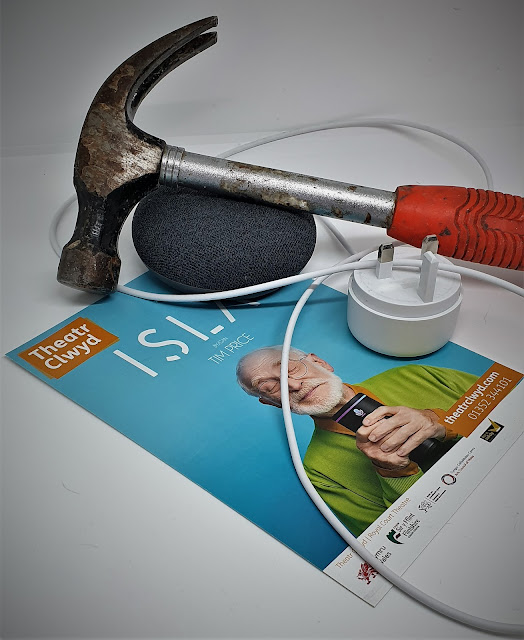
Isla, a new play by Tim Price, is a co-production between Theatr Clwyd and the Royal Court and directed by Theatr Clwyd’s Tamara Harvey. It explores the relationship between a man and a voice activated digital assistant during the period of lockdown.

Roger’s daughter, Erin, is concerned that her father will be alone during the pandemic and that he’ll forget to take his daily medication. She buys him Isla (think Alexa or Siri) and she will help Roger with his shopping orders, relay telephone calls to him when he has mislaid his ‘phone, remind him to take his tablets each morning – she can even play music when he’s feeling a bit lonesome. Roger is not convinced and explains to Erin (Lisa Zahra) that he takes his statins every morning as soon as the morning newspaper is delivered. He has his own routine; he doesn’t need her interfering in his life.

Erin is clearly worried about her father and concerned that during the pandemic she won’t be able to pop in as freely as she used to. They must keep their distance, so Isla will be a great help. Despite her persuasive attitude, Roger (Mark Lambert) is not convinced, he doesn’t want this technology infiltrating his life, he’s not ready to embrace this new world, and we witness the hilarity and hatred of the digital age as he tries to interact with this machine, literally pulling the plug on it as it continues to frustrate him. But soon stubbornness becomes inquisitiveness and Isla is plugged back in. Roger is in lockdown, he can’t interact with people anymore and as loneliness takes hold, he begins to have conversations with Isla. First of all he asks simple questions and he is taken aback by Isla’s breadth of knowledge, and soon quiz questions turn into shared memories with her, he voices his concerns, his anxieties, his frustrations at not being able to interact with living human souls.

There is a particularly poignant moment when Roger asks Isla to phone his daughter as he desperately wants to talk to her, but he knows she is busy at work, so he tells Isla to stop the call. He then asks her to make the call…then stop the call. This struggle between wanting to speak to his daughter but equally not wanting to be a burden is heart wrenching and shows that technology can never replace the importance of human interaction. We suddenly have such empathy for Roger that we are shocked by what happens next.

Lambert is superb as Roger; we spend each passing day in his company, witnessing the daily monotony of the newspaper delivery, boiling the kettle for a morning cuppa, taking medication; a never-ending cycle of the humdrum of life. A life spent yearning for normality to return…for a father to be able to hug his daughter. We’re called to think about the loneliness of the elderly, how the young are slaves to the workplace if they want to achieve anything, and how today’s modern living can mean relinquishing your privacy.

Kind, sweet, lonely Roger starts to throw a curve ball, he’s become so used to Isla he now throws the same casual abuse at it as I have often done to my Satnav. Casual abuse turns into sexist phrases. But this is a machine, you can’t demean a machine, there’s no harm in a light bit of banter is there? Maybe not for Isla, but Erin used her account to set up the digital assistant for her father – his words become her words, and words have dire consequences. A new layer of complexity is added to the play, a darker more thought-provoking piece of writing. As Catrin Aaron, the voice of Isla, appears on stage in police uniform, you realise that words do have consequences when they are misapplied. Roger is quizzed by PC Jones about the language he has been using, the meaning of the words he has chosen to direct at Isla, the intention that they imply. All too soon we must consider the harsh reality of the links between hate speech and domestic violence. It seems a far reach, but then consider that until very recently, digital assistants have been female. Female names, female voices…servants by any other name and therefore to be treated as dirt.

It's an interesting question why digital assistants have always been female. Some companies have advised it is because the human brain is developed to like female voices; but we know women receive criticism for being “screechy” so this excuse doesn’t really work. Microsoft said it found a female voice to best embody the qualities expected of the digital assistant—helpful, supportive, and trustworthy. Perhaps the real truth of the matter is that companies don’t want to admit to gender bias. A digital assistant is there to be bossed about, Alexa do this, Cortana do that…and up until recently, society expected women to fulfil these roles. And if you lose your temper to a female device, why can’t that spill over into a real domestic setting?

Whilst we don’t see Lambert and Zahra on stage together for much of the play, we still get a sense of their deep connection as father and daughter, and it makes the final scenes even more important, showing that a machine can’t give the love and support that a person needs. Digital assistants...anyone got a hammer?!


Isla by Tim Price https://www.bloomsbury.com/uk/isla-9781350280427/

Theatr Clwyd - Emlyn Williams Theatre until 6th November 2021

Roger: Mark Lambert
Erin: Lisa Zahra
Isla/PC Jones: Catrin Aaron


Isla has come to BBC4. Watch the TV version starring the same cast on the BBC 

Absurd Person Singular by Alan Ayckbourn– 12th October 2021 – Theatr Clwyd

Three married couples. Three kitchens. Three Christmas parties.

Yes, I know it’s October and I’ve mentioned the “C” word, but forgive me, this was another of those long-awaited productions delayed by covid that I’ve been itching to see and believe me it could have been worse; when the tour started in Derby they were having Christmas in June!

Sidney Hopcroft doesn’t have much going for him, he’s uneducated, charmless, a local tradesman, but he has a will and a desire to succeed. His wife Jane is the typical suburban 1970’s housewife, lacking ambition and maintaining a spotless home. And I do mean spotless. The play opens in the Hopcroft’s kitchen and Jane is cleaning. Cleaning, cleaning, cleaning. Everything must be perfect tonight; somehow, Sidney has persuaded her to throw a Christmas Eve party to impress his bank manager and a local architect.

As the celebrations begin, unsurprisingly, these three odd couples all end up in the kitchen – I mean this is a party and all the best parties I’ve ever frequented have ended up in the kitchen. You can tell a lot about someone from their kitchen or at least that’s what banker Ronald and his wife Marion think. This tiny, bright orange Formica kitchen might not be to everyone’s taste, certainly not Marion’s, but it is spotlessly clean, and it has simple mod cons like an automatic washing machine which Jane is so excited to tell her guests about. Chaos reigns supreme and the atmosphere changes from quiet anticipation to hilarity as the audience witness the comic capers of the Hopcroft’s as they desperately try to win over the Jacksons and Brewster-Wrights.

How many people does it take to change a lightbulb? Six according to Alan Ayckbourn - one to try committing an act of suicide and five to be so self-absorbed that they don’t notice. It’s a year later, and it’s the turn of architect Geoffrey Jackson and his wife Eva to host the Christmas festivities. Eva is sat in a more upmarket traditional pine kitchen, it feels more spacious than the Hopcroft’s kitchen, but void of any personality. There’s no automatic washing machine here, instead laundry is dumped in a basket in the corner; the oven is filthy and crumpled bits of paper adorn the floor. Sat at a cluttered kitchen table, Eva is penning a suicide note, but her husband is too wrapped up rummaging through the cupboards trying to find some drinks for the evening’s party which he’d forgotten about. Enter Jane, wearing slightly better clothes than last year, but still obsessively cleaning. As Geoffrey and Eva’s world is falling apart, she fills a bowl with water and merrily chats and sings to herself as she scrubs their oven clean, blissfully unaware of the dark torment raging in Eva’s head. Helen Keeley deserves a special mention for the way she managed to convey so much emotion as the catatonically depressed Eva, despite remaining mute for most of Act Two.

The third and final Christmas and more cracks are beginning to show as the tables have turned on the fortunes of our three couples. A quick transformation of the stage and we’re sitting in the freezing dining room, just off the kitchen, of the Brewster-Wrights. Eva has transformed from the suicidal blond to the supportive friend to the alcoholic Marion who no longer cares about her appearance and is oblivious to the cold as she flounces around in her nightdress.

Ronald’s bank now depends on the deposits from Sidney whose business has slowly and steadily grown. After the literal collapse of one of Geoffrey’s architectural designs, he is now dependent on working on Sidney’s housing projects – something that he poured scorn on only a few years earlier. But needs must if you want to keep the roof over your head. The comic twists and poignant moments take another turn as the Jacksons and Brewster-Wrights pretend to not be at home when the Hopcroft’s arrive.

There’s an element of Chekhov despair drifting throughout the play; Sidney and his little wife were a joke, their role was to flatter the egos of their betters; but now, they are the ones calling the shots. During the last act Sidney, once nervous and desperate to find favour, has a newfound confidence and has everyone dancing to his own tune as he demands that everyone plays his party games. He has brought gifts, knowing full well the compliment can no longer be reciprocated. He did what he had to do in the 1970’s get rich culture to make something of himself, whilst the lazy banker and architect let the grass grow under their feet and their wives found solace at the bottom of a bottle of gin or a packet of anti-depressants. Let’s hope Sidney remembers what rises to the top can quickly sink to the bottom if he’s not careful.

Just like Dickens’ ghosts of Christmas Past, Present and Future, Absurd Person Singular takes you on a journey of self-awareness; but rather than a selfish man trying to redeem himself, this play takes you on an emotional roller coaster through the nuances of the different classes, how they look at themselves and each other, and it gives a comic nod to the dangers of holding social gatherings. This is not a play stuck in the 1970’s, sadly it remains prescient today. We don’t need to throw parties anymore to try to impress, we’re now a society obsessed with social media, wanting to achieve the unattainable…whatever the cost.


Cast


Sidney Hopcroft: Paul Sandys
Jane Hopcroft: Felicity Houlbrooke
Geoffrey Jackson: John Dorney
Eva Jackson: Helen Keeley
Ronald Brewster-Wright: Graham O’Mara
Marion Brewster-Wright: Rosanna Miles

The 2021 tour concluded at Theatr Clwyd.


Currently Trending