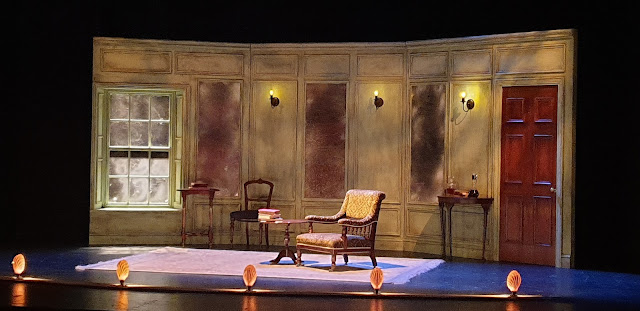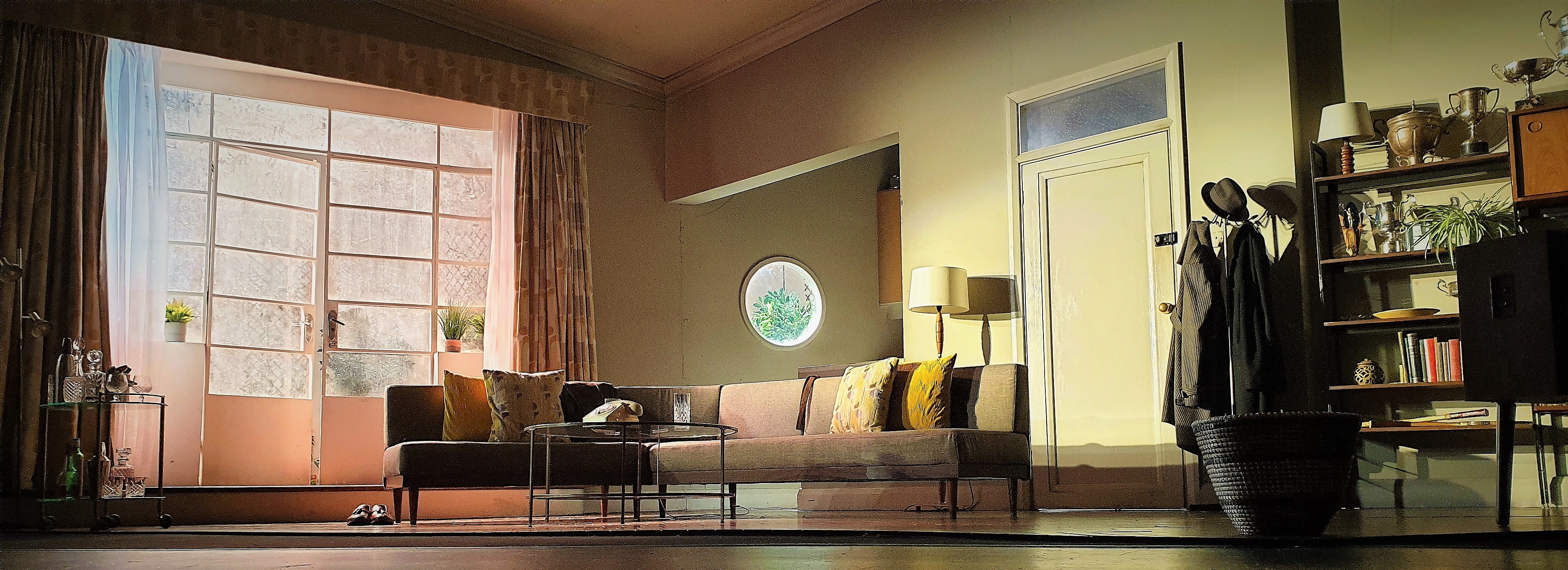
Isla – 18th October 2021 – Theatr Clwyd

I have a love hate relationship with technology. When I was at university in the 90’s, those around me worked on computers whilst I had an electronic typewriter that seemed to have a mind of its own. I think I was nearly 30 before I finally succumbed to enter the modern age and buy myself a laptop.

When I was driving somewhere new, I would study my map book – I would work out which route I was to take and write down the major junctions I needed on post-it notes which I’d stick to my dashboard…discarding each one as I travelled along my hosen route. Now of course it’s much easier, I never bought a Satnav but I have become reliant on Google Maps on my phone…or as I call it Satnav Woman. 

Satnav Woman is brilliant...until she isn’t. She can tell you which route to take and then reroute if there’s an accident or heavy traffic ahead, but she can also be a bit slow telling you where to go, or perhaps a little unclear in her meanings. And then there are the times when she just won’t listen. It’s times like these that Satnav Woman and I will get into a little spat.

SATNAV: “Make a U-turn.”

ME: “I can’t – there are cones down the centre of the road.”

SATNAV: “Make a U-turn.”

Me: “I can’t, it clearly states no U-turn on the signs ahead.”

SATNAV: “Make a U-turn.”

ME: clearly very agitated “Which part of I CAN’T don’t you understand you stupid Bi**h?”

Now I’ve always thought of my interactions with Satnav Woman mildly entertaining. I mean why would you lose your temper with an inanimate object? It makes no sense, and in a rational world you wouldn’t. But perhaps we don’t live in a rational world anymore. Perhaps it’s normal to start shouting “what do you mean” when she’s telling you to “keep left to go right at the fork.” Perhaps I’ve been looking at my interactions with Satnav Woman all wrong.

Isla, a new play by Tim Price, is a co-production between Theatr Clwyd and the Royal Court and directed by Theatr Clwyd’s Tamara Harvey. It explores the relationship between a man and a voice activated digital assistant during the period of lockdown.

Roger’s daughter, Erin, is concerned that her father will be alone during the pandemic and that he’ll forget to take his daily medication. She buys him Isla (think Alexa or Siri) and she will help Roger with his shopping orders, relay telephone calls to him when he has mislaid his ‘phone, remind him to take his tablets each morning – she can even play music when he’s feeling a bit lonesome. Roger is not convinced and explains to Erin (Lisa Zahra) that he takes his statins every morning as soon as the morning newspaper is delivered. He has his own routine; he doesn’t need her interfering in his life.

Erin is clearly worried about her father and concerned that during the pandemic she won’t be able to pop in as freely as she used to. They must keep their distance, so Isla will be a great help. Despite her persuasive attitude, Roger (Mark Lambert) is not convinced, he doesn’t want this technology infiltrating his life, he’s not ready to embrace this new world, and we witness the hilarity and hatred of the digital age as he tries to interact with this machine, literally pulling the plug on it as it continues to frustrate him. But soon stubbornness becomes inquisitiveness and Isla is plugged back in. Roger is in lockdown, he can’t interact with people anymore and as loneliness takes hold, he begins to have conversations with Isla. First of all he asks simple questions and he is taken aback by Isla’s breadth of knowledge, and soon quiz questions turn into shared memories with her, he voices his concerns, his anxieties, his frustrations at not being able to interact with living human souls.

There is a particularly poignant moment when Roger asks Isla to phone his daughter as he desperately wants to talk to her, but he knows she is busy at work, so he tells Isla to stop the call. He then asks her to make the call…then stop the call. This struggle between wanting to speak to his daughter but equally not wanting to be a burden is heart wrenching and shows that technology can never replace the importance of human interaction. We suddenly have such empathy for Roger that we are shocked by what happens next.

Lambert is superb as Roger; we spend each passing day in his company, witnessing the daily monotony of the newspaper delivery, boiling the kettle for a morning cuppa, taking medication; a never-ending cycle of the humdrum of life. A life spent yearning for normality to return…for a father to be able to hug his daughter. We’re called to think about the loneliness of the elderly, how the young are slaves to the workplace if they want to achieve anything, and how today’s modern living can mean relinquishing your privacy.

Kind, sweet, lonely Roger starts to throw a curve ball, he’s become so used to Isla he now throws the same casual abuse at it as I have often done to my Satnav. Casual abuse turns into sexist phrases. But this is a machine, you can’t demean a machine, there’s no harm in a light bit of banter is there? Maybe not for Isla, but Erin used her account to set up the digital assistant for her father – his words become her words, and words have dire consequences. A new layer of complexity is added to the play, a darker more thought-provoking piece of writing. As Catrin Aaron, the voice of Isla, appears on stage in police uniform, you realise that words do have consequences when they are misapplied. Roger is quizzed by PC Jones about the language he has been using, the meaning of the words he has chosen to direct at Isla, the intention that they imply. All too soon we must consider the harsh reality of the links between hate speech and domestic violence. It seems a far reach, but then consider that until very recently, digital assistants have been female. Female names, female voices…servants by any other name and therefore to be treated as dirt.

It's an interesting question why digital assistants have always been female. Some companies have advised it is because the human brain is developed to like female voices; but we know women receive criticism for being “screechy” so this excuse doesn’t really work. Microsoft said it found a female voice to best embody the qualities expected of the digital assistant—helpful, supportive, and trustworthy. Perhaps the real truth of the matter is that companies don’t want to admit to gender bias. A digital assistant is there to be bossed about, Alexa do this, Cortana do that…and up until recently, society expected women to fulfil these roles. And if you lose your temper to a female device, why can’t that spill over into a real domestic setting?

Whilst we don’t see Lambert and Zahra on stage together for much of the play, we still get a sense of their deep connection as father and daughter, and it makes the final scenes even more important, showing that a machine can’t give the love and support that a person needs. Digital assistants...anyone got a hammer?!


Isla by Tim Price https://www.bloomsbury.com/uk/isla-9781350280427/

Theatr Clwyd - Emlyn Williams Theatre until 6th November 2021

Roger: Mark Lambert
Erin: Lisa Zahra
Isla/PC Jones: Catrin Aaron


Isla has come to BBC4. Watch the TV version starring the same cast on the BBC 

Absurd Person Singular by Alan Ayckbourn– 12th October 2021 – Theatr Clwyd

Three married couples. Three kitchens. Three Christmas parties.

Yes, I know it’s October and I’ve mentioned the “C” word, but forgive me, this was another of those long-awaited productions delayed by covid that I’ve been itching to see and believe me it could have been worse; when the tour started in Derby they were having Christmas in June!

Sidney Hopcroft doesn’t have much going for him, he’s uneducated, charmless, a local tradesman, but he has a will and a desire to succeed. His wife Jane is the typical suburban 1970’s housewife, lacking ambition and maintaining a spotless home. And I do mean spotless. The play opens in the Hopcroft’s kitchen and Jane is cleaning. Cleaning, cleaning, cleaning. Everything must be perfect tonight; somehow, Sidney has persuaded her to throw a Christmas Eve party to impress his bank manager and a local architect.

As the celebrations begin, unsurprisingly, these three odd couples all end up in the kitchen – I mean this is a party and all the best parties I’ve ever frequented have ended up in the kitchen. You can tell a lot about someone from their kitchen or at least that’s what banker Ronald and his wife Marion think. This tiny, bright orange Formica kitchen might not be to everyone’s taste, certainly not Marion’s, but it is spotlessly clean, and it has simple mod cons like an automatic washing machine which Jane is so excited to tell her guests about. Chaos reigns supreme and the atmosphere changes from quiet anticipation to hilarity as the audience witness the comic capers of the Hopcroft’s as they desperately try to win over the Jacksons and Brewster-Wrights.

How many people does it take to change a lightbulb? Six according to Alan Ayckbourn - one to try committing an act of suicide and five to be so self-absorbed that they don’t notice. It’s a year later, and it’s the turn of architect Geoffrey Jackson and his wife Eva to host the Christmas festivities. Eva is sat in a more upmarket traditional pine kitchen, it feels more spacious than the Hopcroft’s kitchen, but void of any personality. There’s no automatic washing machine here, instead laundry is dumped in a basket in the corner; the oven is filthy and crumpled bits of paper adorn the floor. Sat at a cluttered kitchen table, Eva is penning a suicide note, but her husband is too wrapped up rummaging through the cupboards trying to find some drinks for the evening’s party which he’d forgotten about. Enter Jane, wearing slightly better clothes than last year, but still obsessively cleaning. As Geoffrey and Eva’s world is falling apart, she fills a bowl with water and merrily chats and sings to herself as she scrubs their oven clean, blissfully unaware of the dark torment raging in Eva’s head. Helen Keeley deserves a special mention for the way she managed to convey so much emotion as the catatonically depressed Eva, despite remaining mute for most of Act Two.

The third and final Christmas and more cracks are beginning to show as the tables have turned on the fortunes of our three couples. A quick transformation of the stage and we’re sitting in the freezing dining room, just off the kitchen, of the Brewster-Wrights. Eva has transformed from the suicidal blond to the supportive friend to the alcoholic Marion who no longer cares about her appearance and is oblivious to the cold as she flounces around in her nightdress.

Ronald’s bank now depends on the deposits from Sidney whose business has slowly and steadily grown. After the literal collapse of one of Geoffrey’s architectural designs, he is now dependent on working on Sidney’s housing projects – something that he poured scorn on only a few years earlier. But needs must if you want to keep the roof over your head. The comic twists and poignant moments take another turn as the Jacksons and Brewster-Wrights pretend to not be at home when the Hopcroft’s arrive.

There’s an element of Chekhov despair drifting throughout the play; Sidney and his little wife were a joke, their role was to flatter the egos of their betters; but now, they are the ones calling the shots. During the last act Sidney, once nervous and desperate to find favour, has a newfound confidence and has everyone dancing to his own tune as he demands that everyone plays his party games. He has brought gifts, knowing full well the compliment can no longer be reciprocated. He did what he had to do in the 1970’s get rich culture to make something of himself, whilst the lazy banker and architect let the grass grow under their feet and their wives found solace at the bottom of a bottle of gin or a packet of anti-depressants. Let’s hope Sidney remembers what rises to the top can quickly sink to the bottom if he’s not careful.

Just like Dickens’ ghosts of Christmas Past, Present and Future, Absurd Person Singular takes you on a journey of self-awareness; but rather than a selfish man trying to redeem himself, this play takes you on an emotional roller coaster through the nuances of the different classes, how they look at themselves and each other, and it gives a comic nod to the dangers of holding social gatherings. This is not a play stuck in the 1970’s, sadly it remains prescient today. We don’t need to throw parties anymore to try to impress, we’re now a society obsessed with social media, wanting to achieve the unattainable…whatever the cost.


Cast


Sidney Hopcroft: Paul Sandys
Jane Hopcroft: Felicity Houlbrooke
Geoffrey Jackson: John Dorney
Eva Jackson: Helen Keeley
Ronald Brewster-Wright: Graham O’Mara
Marion Brewster-Wright: Rosanna Miles

The 2021 tour concluded at Theatr Clwyd.


Being Mr Wickham – 8th October 2021 – Theatr Clwyd

Back in 1995, the BBC made what I would consider the quintessential adaptation of Jane Austin’s 1813 novel Pride and Prejudice. The six-part series elevated actor Colin Firth to fame when he set hearts a flutter whilst striding out of the lake at Pemberley as the dashing Mr Darcy, wet white shirt dripping and clinging to his torso. The foil to Mr Darcy was George Wickham, played by Adrian Lukis, a man who shared his history with Darcy.

Wickham was a charming militia officer who manged to attract the sympathy of the heroine Elizabeth Bennett. She believed Darcy to have mistreated Wickham in the past and it took the interaction of her aunt to forewarn her that the path to happiness was most certainly not to be found in George Wickham. As the story continues, the aunt’s warning plays out and it is revealed that Wickham is a manipulative cad. He is a wastrel, a compulsive liar, a seducer and live the life of a rake…in fact Jane Austin doesn’t really have anything nice to say about the man.

Now whilst I could never envisage dear Lizzie Bennet ending up with the dastardly Mr Wickham, I must confess to having a bit of a soft spot for him; I mean think of Dolokhov in Tolstoy’s War and Peace, you’re not really supposed to like him, but there’s just something utterly compelling about these characters. I think Dolokhov was rather misunderstood, the question is, was George Wickham?

‘Am I to be the villain of my own story?’

You may recall that our last image of Wickham is when Darcy forces him to make an honest woman of Lydia Bennett after he has eloped with her. So, what happens to Wickham after Pride and Prejudice has ended? Adrian Lukis is back as Mr Wickham and this play he has written and stars in attempts to provide an answer. It’s time to push Mr Darcy to one-side and give George Wickham a chance to put the story straight, after all, he isn’t going to tell the same tale that Jane Austin would.

It is Wickham’s 60th birthday, following a flirtation at his party, his wife Lydia has stormed off to bed leaving him all alone with a bottle of claret and a whole host of memories for company. Just as we can’t forget Mr Darcy, neither can he, his takes us back to his earliest encounter with Darcy when they were children, through the period we bore witness to in Pride and Prejudice, to what happened after they were both married. There are often two sides to a story, and the storyteller will always tell you the rose-tinted spectacle version.


Adrian Lukis is a charismatic actor, making you hang onto his every word as he draws you back into being complicit with Wickham’s bad boy behaviour of the past. Wickham’s currently worried by his diminishing looks and his aging knees, "I'm told I'd pass for 40" … "on a good day." That pause, that sigh, the raised eyebrow…how can you not be transfixed by this scoundrel?

Being Mr Wickham is a fervent defence of a man the audience knows cheated and lied to gain every advantage he could. He was willing to accept his life as a vicar. He genuinely loved Georgiana. He had a perfectly acceptable defence of his elopement with Lydia. He has told these stories to himself so many times that he now truly believes in them. His trip down memory line is so far apart from Jane Austin’s you’d be forgiven for thinking that two different people were being explored. But this is what makes the play so engaging – to hear a different perspective. Austin would be horrified that Wickham could potentially have a softer, kinder side, but we know from his past he manipulated those around him…and a leopard doesn’t change his spots. Just as Elizabeth Bennett fell for his charms, he now has a whole audience eating out of his hand, hanging onto his every word as he charms his way through this hour-long production making the audience laugh along the way.

‘When Lydia is happy, I am happy; When Lydia is asleep, I am delighted.’

It’s a well-balanced play; whilst there’s a melancholy to some of his reminiscences, there are elements of light to the shade, although often these lighter moments point to a life that’s not as happy as it may seem, ‘When Lydia is happy, I am happy; When Lydia is asleep, I am delighted.’ As he wanders over to the window to watch the comings and goings of his neighbours, his excitement is palpable about the possibility of his next-door neighbour’s daughter eloping.

The writing is particularly vivid as Wickham recalls the Battle of Waterloo; the walls of the set turn dark, and a military uniform appears from what were frosted windows, and he recalls the demise of his dear friend Denny, shot next to him on the battlefield. He Byronesque persona shone through as he recalled the losses of various courtesans he knew and loved, and other people who had passed through his life who were no longer there to share in his current trials and tribulations.

We journeyed through all his life…his childhood and his mother abandoning him and how young Darcy took the wrap for young Wickham stealing a bottle of Brandy. We learnt how unhappy he was at school, how Darcy paid him off instead of him having a career within the church and how he spent that money chasing wine, women and song. How he remained with Lydia because they made each other laugh, but despite everything this was not a man to feel sorry for. He has had his ups and downs like anyone else.

Just as Colin Firth is Mr Darcy, Adrian Lukis is Mr Wickham and it was a delight to see the character brought back to life as the layers of his life were peeled away like an onion. There was a reason he could charm the Bennett sisters, and throughout the evening he charmed the audience just as easily. It was a joy to watch this thoughtful “sequel” to Pride and Prejudice which fans of the novel could delight in and an even bigger joy and surprise when Adrian returned to the stage as himself to take part in a short Q&A session which was just as entertaining as the play.

If you ever get the chance to see this delightful one-man show – take the opportunity as it’s worth it.

2021 Tour dates:

Theatr Clwyd (8-9 October)
Darlington Hippodrome (11-12 October)
York Theatre Royal (14-16 October)
The New Wolsey Theatre, Ipswich (19-20 October)
Connaught Theatre, Worthing (21-22 October)
Yvonne Arnaud Theatre, Guildford (28-30 October)
The Haymarket, Basingstoke (1-2 November)
Devonshire Park Theatre, Eastbourne (4-6 November)


UPDATE!  The tour might be over but you can watch online until 30/04/2022 - https://originaltheatreonline.com/productions/28/being-mr-wickham


The Hound of the Baskervilles – 21st September 2021 – Theatr Clwyd

After the last 18 months, we all could all do with exercising those chuckle muscles a bit and where better to do it than by watching live theatre? Sir Arthur Conan Doyle’s most celebrated adventure has been given the most glorious comic transformation by the Original Theatre Company.

The world-renowned detective Sherlock Holmes and his ever-faithful sidekick Dr Watson are tasked with unravelling a mystery regarding the untimely death of Sir Charles Baskerville. Rumours abound that there is a cursed giant hound roaming the moors which surround the Baskerville home, so it is up to Holmes and Watson…or should that be Watson and Holmes, to use their wit and guile to save the remaining Baskerville heir from succumbing to the same fate that has befallen Sir Charles.

This ingenious adaptation combines wonderful comic performances by all three cast members who take on a variety of roles throughout the evening. Serena Manteghi plays a whole host of colourful characters, she is a delight as both Sir Charles Baskerville and Sir Henry Baskerville, and she swiftly morphs into a London cabbie and three yokels of varying degrees of intelligence. Dr Watson, played by Niall Ransome, is the competent, incompetent, faithful sidekick played with puppy like charm, whilst Holmes played by Jake Ferretti retains an element of that emotional distance that Holmes is renowned for.


The show is a parody of many theatrical styles, there are moments of melodrama intertwined with the farcical and bordering on a night at the panto. Whilst the show starts rather gently, the momentum continues to build; the actors change characters, gender, accents, and costumes at lightning speed; or at least that’s what I thought. After the interval, Jack Ferretti came back on stage rather ruffled by a Twitter notification during the break, so we were treated to a resume of the play at warp factor! My sides were aching at the sheer ludicrousness of it all…and that’s before we were treated to a Tango worthy of Strictly!

More camped up spooky Scooby Doo whodunnit than scary crime drama, it’s a great excuse to treat the family to a fun filled night out, and after the last couple of years, who wouldn’t want that?!

The Hound of the Baskervilles - produced by The Original Theatre Company & Octagon Theatre Bolton


Jake Ferretti: Sherlock Holmes
Serena Manteghi: Sir Henry
Niall Ransome: Dr. Watson

 2021/2022 Tour dates:

Cambridge Arts Theatre (16-18 Sept)
Theatr Clwyd (21-25 Sept)
Exeter Northcott Theatre (28 Sept-2 Oct)
Malvern Theatres (5-9 Oct)
York Theatre Royal (19-23 Oct)
Devonshire Park Theatre, Eastbourne (26-30 Oct)
Richmond Theatre (2-6 November)
The New Wolsey Theatre, Ipswich (9-13 Nov)
Salisbury Playhouse (15-20 Nov)
Theatre Royal Bath (24-28 Jan)
The Lowry (31 Jan – 5 Feb)
Belgrade Theatre, Coventry (8-12 February).

 Further 2022 tour venues are to be announced.


Dial M for Murder - – 27th September 2021 – Theatr Clwyd

Retired champion tennis player Tony Wendice (played by Strictly Come Dancing winner Tom Chambers) wants to murder his socialite wife Margot (X-factor finalist Diana Vickers.) Not only has Margot been unfaithful to her husband by having an affair with crime writer Max Halliday, but she’s also sitting on a small fortune which her husband needs to get his hands on the because he’s broke. Whilst he may have several trophy’s lining his front room shelves, he was playing tennis in an era where tennis players weren’t paid.


Many people will be aware of Alfred Hitchcock’s 1954 film version of Dial M for Murder starring Ray Milland and Grace Kelly, however, it was BBC television that first aired a production in 1952; the same year that a theatrical version was also performed.

As I loved Hitchcock’s version, I was rather excited to finally watch this play; I’d bought tickets pre-covid when the tour was first announced, but unfortunately the production had to be postponed several times until it was deemed safe to reopen our theatres and touring could commence.

Is there such a thing as the perfect crime?

Tony has spent months perfecting the perfect murder, however, he’s a coward who won’t get his hands too dirty, so he enlists the help of an old acquaintance from his Cambridge University days, Charles Swann. Tony is aware that Charles became a small-time criminal and because this is the perfect crime, he can use his knowledge of Charles’ history to his advantage. He arranges a meeting with Swann, claiming he wishes to purchase the car Swann is selling, but over a few drinks, he confides in Swann about Margot’s infidelity. Six months earlier, Tony had stolen Margot’s handbag which contained a love letter from Mark, and he sent her an anonymous blackmail letter about it. Whilst confiding in Swann, Tony hands him the love letter to read, now that the letter has Swann’s fingerprints all over it, Tony tells Swann he can either accept £1000.00 to murder Margot, or he can be unveiled as the mystery man who blackmailed her. Swann grudgingly agrees to become Tony’s accomplice, and Tony explains his perfect plan for murder…

Oh what a tangled web we weave, 
When first we practice to deceive'…

 Mark Halliday is back on UK soil and visiting Margot. Tony tells Mark he should accompany him to a stag party the following evening thus leaving Margot home alone. Tony will hide Margot’s door key under the mat so that Charles can let himself into the property and hide. Tony would then telephone Margot from the party and whilst answering the phone, Charles would strangle her and then leave signs of a burglary before leaving the flat and replacing the door key back where he’d found it. Now the only problem with Tony’s plan is that it is reliant on everyone playing their part perfectly, and the only fly in the ointment is that Margot doesn’t know what her role in his devious scheme entails. So, just like Marmion, we’re about to witness a domino effect of complications which begin to spiral out of control.

Set in the front room of a ground floor flat in Maida Vale, this production is set a decade later than the original, a transformation that doesn’t add anything to this clunky new production of the classic thriller. The soundtrack opening the show is the 1959 classic The Flamingos - I Only Have Eyes For You, which immediately transported me back to The Deep Blue Sea at The National with Tom Burke and Helen McCrory. I say the production was clunky, because whilst I enjoyed the play, it wasn’t the edge of the seat spine-chilling thriller I was expecting. Instead, director Anthony Banks has injected a light-heartedness into the staging, which suits Tom Chambers’ acting style, but means that parts of the play which should be extremely dramatic, elicit raucous laughter from audience.

Tom Chambers appears to be having great fun playing the role of psychopath Tony Wendice, but he is too maniacal, and it undermines the cold calculated mind of a wife killer; I also found the smug self-esteem overbearing and the references to his past tennis career in his dancelike movements across the stage unnecessary.

Whilst all the actors were good, I felt there was a distinct lack of chemistry between the central trio, which made the whole plot unbelievable, and I didn’t really care who was sent to the gallows in the end.  And then there was the murder itself.

The joy of this storyline is that the audience has had it spelt out to them from the start what is supposed to happen. The tension in the air should become palpable as we move through Tony’s plan and see it start to fracture, but the comedic edge dilutes the tension. There isn’t that sense of shock from Margot, surprise yes, but not a deep dark horror that someone has just tried to kill her. The murder scene needed more conviction to keep me on the edge of my seat.

It was an enjoyable evening out, but it was less thriller and more comedic caper for my liking; but maybe a bit of tactical light relief is what people need in the current climate, and if that’s what the audience want – this production delivers on that front.


Dial M for Murder

Theatr Clwyd – Anthony Hopkins Theatr from

Running time 2 hours 20 mins

Tony Wendice: Tom Chambers

Margot Wendice: Diana Vickers


27 September – 2 October 2021 Theatr Clwyd, Mold
5 – 9 October 2021 Cambridge Arts Theatre
11 – 16 October 2021 Everyman Theatre, Cheltenham
18 – 23 October 2021 Lyceum Theatre, Sheffield
26 – 30 October 2021 Milton Keynes Theatre
2 – 6 November 2021 New Theatre Cardiff
9 – 13 November 2021 Palace Theatre, Southend On Sea
15 – 20 November 2021 The Lowry, Salford
29 November – 4 December 2021 Festival Theatre Malvern


Missing Julie - by Kaite O'Reilly - Theatr Clwyd 17th Sep 2021 (Preview)

Theatr Clwyd - 2020 Regional Theatre of the Year. It’s easy to see why. During the darkest days of the pandemic, the theatre not only got involved with the local community, but it continued to strive to help creatives in the industry. An opportunity to stream several free online readings whilst the theatre curtain remained drawn was also grabbed.

On 5/11/2020, a reading of Kate O’Reilly’s brand-new play Missing Julie was aired. Over a coffee in the theatre, the foundations of relocating Strindberg’s classic Miss Julie to post-war Wales had begun to take shape. Performed by Sophie Melville (The Missing, The Pact); Tim Pritchett (Casualty, Black Mirror); and Victoria John (Miranda, Little Britain) I enjoyed the reading and looked forward to a time when the play would grace the stage of Theatr Clwyd.

Set in a Welsh stately home in 1921, just after the First World War, Missing Julie is described as a modern adaptation of Strindberg’s Miss Julie. Whilst the story has moved to a century ago, it still feels like a contemporary piece, but it allows the dynamic between the characters to be strengthened and throughout it still remains faithful to the original storyline. After the war was a period of grief and mourning, but for some it was also a period of change, of hope, of possibilities. Many men returned home with missing limbs and this play explores their lives and the interactions they had after returning home.

The play is performed in Theatr Clwyd’s “Emlyn Williams Theatr” an intimate space which allowed Georgia Lowe’s simplistic but effective traverse staged set design. Just like when I watched Miss Julie in Keswick a few years ago, https://www.imblatheringnow.com/2017/09/miss-julie-theatre-by-lake-keswick.html the audience watches the action from either side of a long kitchen table. Whilst Keswick’s set was a homely kitchen, this set is spartan matt black, with Perspex walls housing flood lights at either end. Large bells hang ominously from each corner of the set, and a large pan is set at the end of the table, bubbling above a burning flame.

Out of the cast who did the online reading, only Tim Pritchett as John remains. Heledd Gwynn takes on the titular role and her performance is mesmerising from the moment the lights go up on stage. Athletic and balletic, she contorts her body in all manner of shapes as John watches on, stating to Christine that the lady of the house has obviously lost her mind. Julie however is not a madwoman, but a heady mixture of contradictions. It is unsettling watching her as she sways from her desperate yearning to be with John, a man deemed to be beneath her, and her reliance on the shackles that bind her to her current lifestyle of the wealthy classes.

Rather than being abandoned by her fiancĂ©, this Miss Julie’s world has been turned upside down as she has lost her man in the carnage of the trenches. She is one of the surplus women, destined to become a spinster. Her father’s servant John has lost a leg, we assume in the war, but it transpires that it was caused by a shooting accident in his youth. It’s not just John who is bearing scars of the past, Christine the cook is also dealing with her own loss; the grief she feels for her dead husband is palpable.

‘What do you know about magnificence?’

John is tired of being working-class, taking his orders from people who are no better than him. He aspires to better things, but this is a simple world of going to chapel, knowing your place and where having aspirations should be met with caution. John may appear to have certain limitations, but he will not let the loss of a limb stop him from pursuing a life away from servitude. He is Julie’s opposite in several ways. John and Julie continually bait and stalk each other throughout the play, but both give focused and assured performances maintaining a sizzling level of tension throughout. We know how the original story pans out, but maybe this time Julie will fathom out what she really wants.

Images as per Twitter Stream

Overseeing all the action is Christine, played by Catrin Aaron. All three actors remain on the stage throughout the play, and as she sleepwalks around the perimeter of the stage, the atmosphere becomes more claustrophobic. The old ways are being swept away and for her this is a heavy burden to bear. Her sudden outburst is heartfelt, and suddenly you realise that from the moment the play begins, to when she says to John “what do you know about magnificence?” she is the one who has the most tragic life of them all.

Whilst this isn’t radically different to the original play, it was thoroughly enjoyable to watch and to look through the eyes of a world that was on the cusp of change. Often disabled characters in classic plays are to be pitied or ridiculed, but Kaite O’Reilly has created an opportunity to give a voice to those who are overlooked or treated with contempt, and she has given them an inner strength. Setting it in a period where many men came back from the war supporting life changing injuries opened a conversation about how people with disabilities are treated, both then and now.

Missing Julie by Kaite O'Reilly

Theatr Clwyd - Emlyn Williams Theatre from 21 September until 9 October.

Running time 75 mins

Julie: Heledd Gwynn

Christine: Catrin Aaron

John: Tim Pritchett

Grayson’s Art Club – Manchester Art Gallery (August 2021)

For people of a certain vintage, they’d come home from school, be handed a glass of Kia-Ora and sit and watch Take Hart with the aroma of fish fingers, chips and beans wafting in the air. For the uninitiated, Take Hart was a BBC children’s TV programme about art, presented by a chap call Tony Hart, who had a Plasticine animated side-kick called Morph. Unlike progressive UK Governments, Tony could see the benefit of encouraging children to be creative. He would demonstrate small-scale projects you could easily try to recreate or adapt, and large-scale projects on the studio floor, or a beach which you’d just watch in amazement. There was a special part of the show “The Gallery” in which young viewers could send in their own artwork and if they were lucky, Tony would select their work and it would be shown on the TV.

The reason for my trip down memory lane is that during lockdown, Grayson Perry, one of Britain’s leading artists, took this idea one step further. No longer just the domain of young children, Grayson and his wife opened the doors of the artworld for everyone; no matter their age, or their ability, everyone was welcome at Art Club. The Channel 4 show was only 6 episodes long, but it quickly brought the British nation together during the first lockdown.

“We want to encourage everyone to express their creativity through art. Art is good for you, whoever you are.”

Each week, Grayson and Philippa would set a creative theme and people would submit their artwork to them. Alongside the artwork submitted by the public, celebratory guests contributed their artwork, and of course Philippa and Grayson shared their creativity with us too.

Nearly ten thousand people submitted their work to Grayson and Philippa, and art chosen by them, and their celebratory guests, was shared on national television and more latterly in an exhibition at Manchester Art Gallery. Grayson was adamant that the exhibition would not be shown in London. In his own words, he loves London, it’s the centre of the British art world, but Art Club wasn’t for the art world, it was for the whole country.

Lockdown Two thwarted Grayson’s plans for opening the exhibition, however, it did allow us a second series of Art Club and offered six new themes for the nation to unleash their creativity. Family, nature, food, dreams, work and travel were the hot topics of series two and once again the country united to explore and share its artwork once more with Grayson, Philippa and Kevin the cat. The divided UK was again united, showing that making art unites us and comforts us in our times of need. Whether it’s going back to childhood with some Lego or grabbing a pencil and paper and scribbling away our unconscious thoughts or fears, art is the therapy that heled many people come to terms with being forced to stay at home.


Now the lockdowns have ended, Manchester Art Gallery is open, and the public can reminisce about those early, dark days of lockdown. The exhibition is an incredible reminder of what we, as a nation went through. It chronicles how we got through the changing mood of the pandemic, from one of fear, to one of anger, to one of unity and tolerance.  

Below are my personal favourites from the exhibition catagories:

Portraits


Grayson Perry 2020 by Nathan Wyburn

When I visit a gallery, I’m not immediately drawn to the portrait section. (Strange when you consider that for the last few years, I returned to drawing by doing portraits of my favourite actor Tom Burke.) I was pleasantly surprised by how many of the portraits spoke to me and there were a few pieces that really caught my attention, but I loved the simplicity of Nathan’s work; how by raiding a few condiments from the kitchen cupboard, he could produce a portrait of Grayson using soya sauce and noodles!

Animals 

Lockdown Birds 2020 by Paul Green

My favourite artist is Georges Stubbs; the way he captures the details of his animals, especially the horses he is famed for is sublime. I was captivated by several animal paintings in this exhibit, but it was these garden birds made of wire that stole this section. The attention to detail in these tiny sculptures brought home the joy these daily garden visitors gave me and watching them have the freedom to go wherever they wanted whilst I was being told I had to stay at home!

Fantasy

ComputerWorld 2020 by Alex Robinson

There was something so endearing about Alex’s fantasy Fimo clay models. They took me back to a time when it was acceptable to lose yourself in a world of make believe. Each character is unique, but all exhibit Alex’s personal style. Best of all, they made me smile, and what could be better than disappearing from the harshness of reality, to take time out and allow yourself to take in the joyfulness of these little characters. 

View From My Window 

Bearded Tit 2020 by Jim Muir (Vic Reeves)

I didn’t feel much connection with this category. I didn’t spend much time looking out of the window during lockdown, but if I did, it was watching the birds on the feeders. It’s like watching a soap opera being played out, the different birds playing their roles to aplomb. I really loved how Jim had stripped our feathered friends back to their most simplistic form and used bold primary colours – a bit of brightness and cheer in the dark days that stretched ahead of us.


Home

At home with my cats 2020 by Ania Newland

Ania’s painting stood out for me as it had an echo of a Mr Man book to it. I don’t make that comment flippantly or disrespectfully – it is the bright colours outlined in black that made the thought pop into my head. And what could be a more homely thought than being a child tucked up in bed having Mr Men books read to them? There was also a hint of longing to be the person sitting on the sofa surrounded by cats. When lockdown began, the only animals I had keeping me sane were the yard cats at work. Things are different now, and heaven forbid, if there’s another lockdown, I have a cat to share my sofa with!

Britain

Thursday 8pm 2020 by Jacqueline Taylor

This image was a stark reminder of lockdown. I think we’ve easily forgotten how bad the early days were, when you could only leave your house to go on a walk (on your own.) The car sat on the driveway unless you were going to work or the supermarket. There was a feeling of being trapped, your home suddenly became your prison; children stuck inside trying to find a way through the school day when formal schooling was no longer an option. And then, without warning, neighbourhoods were showing signs of solidarity – windows were being bestowed with children’s paintings of rainbows. This wasn’t a new concept, it had started in Italy, one of the first European countries to be hit hard by Covid. In Italy the art was accompanied by the phrase ‘AndrĂ  Tutto Bene’, or All Will Be Well. The rainbow was a simple way for children to show their appreciation for the NHS – and on a Thursday evening at 8pm, residents up and down the country joined together and clapped for their overstretched NHS. If there is one piece of art in the whole exhibition which has a historical context to it, it’s this one. In ten years’ time, if we look at it again, those memories of lockdown will come flooding back.


Grayson’s Art Club exhibition feature art from series one is currently open at Manchester Art Gallery until 31st October 2021.


Grayson’s Art Club exhibition featuring art from series two is due to open at Bristol Museum & Art Gallery 4th December 2021 - 8th May 2022.


  PS. When you're leaving the exhibition - look closely in one of the cabinets in the tea exhibition...that Jane Austen pot doesn't just look like a Grayson Perry pot...it is a Grayson Perry pot!

Currently Trending